

Location: 1255 Clubhouse Dr, Pasadena, CA 91105 Administrative Status: Park/Garden, Carrier Route C020 Region: Los Angeles County
In real estate databases, this object often appears as a dry string of coordinates. However, hidden behind the address 1255 Clubhouse Dr lies one of the most intriguing and secluded corners of Southern California — Johnston Lake.
In modern medicine, there is a field known as Environmental Psychology, which studies how surrounding spaces influence our physiology. This location serves as an ideal case study for how architecture, history, and nature can combine to turn a residence into a therapeutic resource.
Below is a detailed analysis of this unique place and a guide on how to apply its health principles in any environment.
Historical and Geographical Context
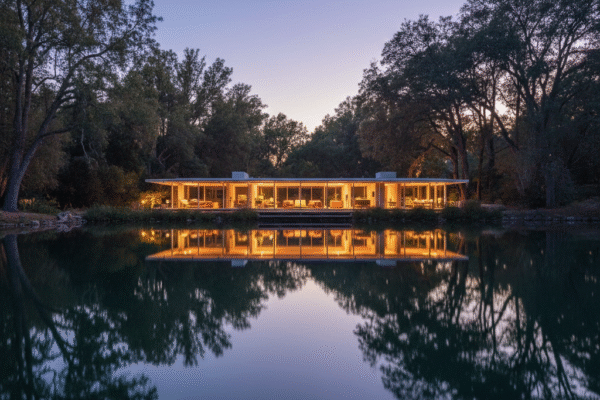
Johnston Lake is not a public park; it is the heart of a private, gated community, accessible only to the residents of approximately 18 homes situated along its shoreline.
-
British Heritage: The history of the site dates back to 1883 when British diplomat Alexander Campbell-Johnston purchased the San Rafael Ranch. The lake was not a natural phenomenon; the family created it by damming a creek in a canyon. They sought to recreate a “Little England” in California, a legacy reflected in the street name Clubhouse Drive (named after the exclusive golf and polo clubs that formed around the estate).
-
Architecture: The residence at the key address (built in 1959) is a prime example of Mid-Century Modern design. Glass walls and terraces blur the boundary between the home and the water, effectively making the building part of the ecosystem.
-
Logistics: The Carrier Route code
C020associated with the address indicates the exclusive service status of this residential zone, hidden away from prying eyes and urban noise.
Medical Perspective: Why This Place Heals
Neurobiology and the ``Blue Mind`` Effect
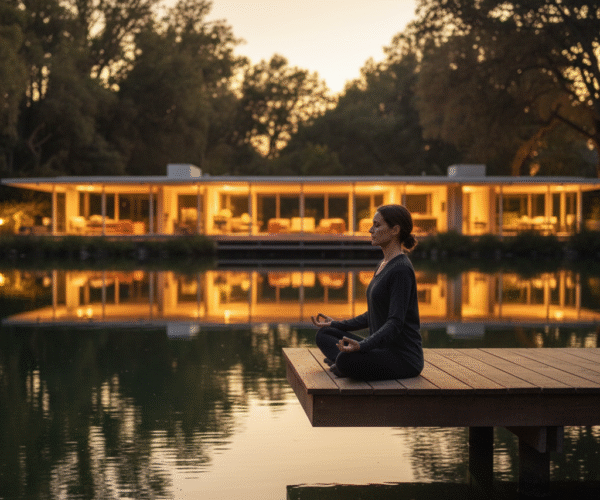
Dr. Wallace J. Nichols introduced the term “Blue Mind.” This refers to a mildly meditative state characterized by calm and peace that occurs when the brain is near water.
-
Mechanism: Viewing a calm body of water switches the nervous system from Sympathetic mode (“fight or flight,” high stress) to Parasympathetic mode (rest and digest).
-
Result: Residents experience a natural reduction in cortisol (stress hormone) and norepinephrine levels. This serves as direct prevention against hypertension, burnout, and anxiety disorders.
Aerophytotherapy and Immunity
The lake is ringed by dense, mature trees, dominated by oaks and eucalyptus.
-
Natural Inhaler: Eucalyptus trees release phytoncides—volatile organic compounds that act as natural antiseptics for the respiratory tract.
-
Viral Protection: Research (such as the Japanese practice of Shinrin-yoku or “forest bathing”) confirms that such an environment boosts the activity of NK cells (Natural Killer cells)—lymphocytes responsible for destroying viruses and tumor cells.
-
Microclimate: The water adds humidity to the dry California air, which alleviates asthma symptoms and reduces the dust load on the lungs.
Acoustic Detoxification
The World Health Organization identifies constant urban noise above 55 dB as a serious risk factor for cardiovascular disease.
-
Sound Barrier: Thanks to its location in a canyon (ravine) and thick vegetation, Johnston Lake blocks out the drone of the metropolis.
-
Impact on Sleep: The prevalence of natural sounds (birds singing, rustling leaves) promotes longer periods of REM sleep, which is critical for neuronal recovery and the prevention of Alzheimer’s disease.
Thermoregulation and Heart Health
In dense urban areas, asphalt and concrete create an “Urban Heat Island” effect, which is dangerous for people with heart conditions.
-
Natural Air Conditioning: The water body absorbs heat from the air through evaporation. This lowers the ambient temperature around the home by 2–4 degrees, reducing the strain on the cardiovascular system during hot days.
Practice: How to Create the ``Johnston Lake`` Effect at Home
You do not need to move to Pasadena to reap the benefits. By using scientific data (biohacking), you can mimic these therapeutic natural signals in any city apartment.
Breathing: The 4-7-8 Technique
Near water, humans reflexively breathe slower. At home, this must be done consciously to activate the Vagus Nerve.
Method (by Dr. Andrew Weil):
- Inhale through the nose for a count of 4.
- Hold the breath for a count of 7.
- Exhale slowly through the mouth (making a “whoosh” sound) for a count of 8
Benefit: The long exhale physically slows the heart rate, while the hold increases carbon dioxide levels, dilating blood vessels and improving oxygen flow to the brain. Perform 4 cycles in the morning and evening.
Sound Therapy: ``Pink Noise``
Instead of harsh “White Noise” (radio static), use “Pink Noise.”
-
What it is: Low-frequency sounds characteristic of nature: rain, wind, rustling leaves.
-
Benefit: Studies show that pink noise synchronizes brain waves during sleep, increasing the duration of Deep Sleep, the phase where the brain “cleans” itself of toxins.
Vision: The ``Soft Fascination`` Effect
Urban environments demand exhausting “Directed Attention.” Nature, conversely, induces a state of “Soft Fascination.”
Action: The brain calms down when looking at fractals—self-repeating natural patterns.
- Place a plant with complex leaf structures (like a fern) on your desk. 40 seconds of viewing reduces stress.
- Watch high-definition videos of water or forests. This can lower the pulse by 3–5 beats per minute.
Smell: Phytoncides in a Bottle
The chemical composition of a eucalyptus grove can be recreated using essential oils.
-
Selection: Look for oils containing pinene and limonene. Best options: Hinoki (Japanese cypress), Siberian Fir, Pine, Eucalyptus.
-
Benefit: Inhaling these aromas lowers salivary cortisol levels and activates the immune system.
Summary: The Evening Restoration Ritual
Light
Dim the lights (mimicking sunset).
Sound
Play quiet background sounds of rain or a stream.
Scent
Use a diffuser with coniferous or eucalyptus oil.
Action
Perform the “4-7-8” breathing exercise.
This comprehensive approach helps reduce systemic inflammation, normalize circadian rhythms, and ensure high-quality rest for the body.