

Nestled among the majestic boulevards of Pasadena, California, stands a building that is not merely an architectural landmark but the very symbol of one of America’s most cherished New Year’s traditions—the Rose Parade. The Tournament House, once the winter residence of “Chewing Gum King” William Wrigley Jr., now serves as a living museum and the official headquarters for the Pasadena Tournament of Roses Association.

Historical Background: The Legacy of a Magnate and ``Millionaire's Row``
The mansion’s story is a classic example of the American Industrial Age, intrinsically tied to the history of Pasadena’s wealthiest neighborhood.
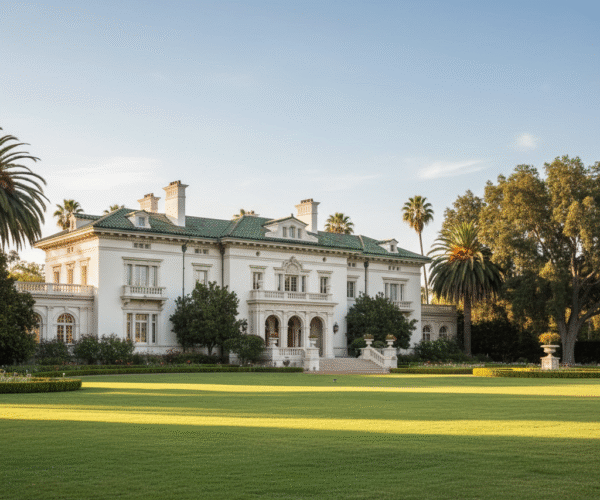
Wrigley Mansion in Pasadena photographed at sunset, showcasing its Italian Renaissance architecture, green tile roof, and expansive front lawn.
AI-generated image based on real photos for illustrative purposes only.

The Early Years (1906–1914)

The estate was designed by architect G. Lawrence Stimson. Due to the high cost of maintenance, it was quickly sold to its most famous owner.

The Wrigley Era

In 1914, William Wrigley Jr. acquired the property. The family used the mansion as their winter escape from the Chicago cold and enjoyed watching the Rose Parade pass right by their grounds.

``Millionaire’s Row``

The mansion is located on Orange Grove Boulevard, a street famously known in the early 20th century as “Millionaire’s Row.” Wrigley Mansion is one of the few grand estates of that era that survived the subsequent urban development.

The Gift

In 1958, the Wrigley family generously donated the mansion to the City of Pasadena under the condition that it would serve as the permanent headquarters for the Tournament of Roses Association.

Architecture and Unique Interior Treasures

The estate spans more than 18,500 square feet and stands as one of the finest surviving examples of Italian Renaissance architecture in Pasadena. Inside, visitors find a 22-room interior lined with rare Circassian walnut and Philippine mahogany, paired with marble inlays and ceilings rich in decorative detail.

Several areas carry a distinct atmosphere.
The Library remains one of the most memorable rooms—a quiet retreat where the Wrigley family once read, talked, and gathered around the radio.
The Crown Room holds a symbolic role as the place where the annual Rose Queen’s crown is kept and displayed.

The mansion also hides a few unexpected relics from the early 20th century, including the original wooden telephone booth and the unusual “Ribcage Shower,” a circular, multi-nozzle bathing system that was considered advanced technology for its time.
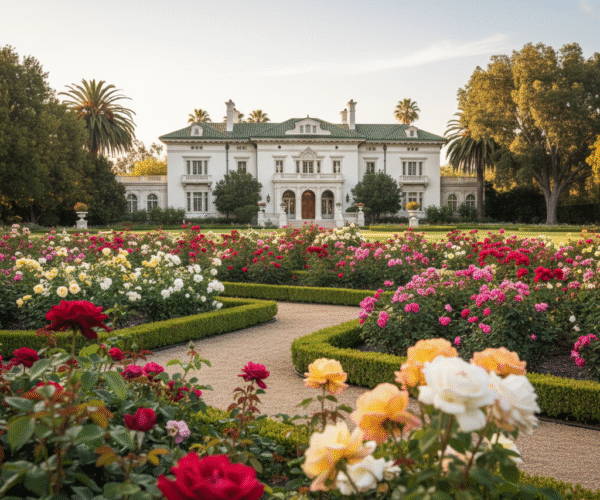
A wide view of Wrigley Gardens with colorful rose beds leading toward the historic Wrigley Mansion on a bright afternoon.
AI-generated image for illustrative purposes only.

The Floral Kingdom: Wrigley Gardens

An essential part of the complex is the Wrigley Gardens, a public amenity spanning 4.5 acres.

The Collection

The gardens showcase over 1,500 varieties of roses, camellias, and other plantings.

Official Status

The site is one of the official testing grounds where new rose varieties are trialed before being granted the prestigious All-America Rose Selections award.

Accessibility

Unlike the house, the Wrigley Gardens are open for free public strolling daily from sunrise to sunset.

Modern Center: HQ and the Rose Bowl Hall of Fame

The Tournament House operates not merely as a museum, but as a dynamic center managing the New Year’s celebrations.

Headquarters

This is the nerve center staffed by 935 dedicated volunteers, known as the “White Suiters,” who work all year to execute the Rose Parade and the Rose Bowl Game.

Sports Sanctuary

The mansion houses the Rose Bowl Hall of Fame, a sanctuary for college football fans. It features historic trophies (including the iconic Waterford Crystal trophy), helmets, and memorabilia from the greatest “Granddaddy of Them All” games.

New Year's Day Command Center

On January 1st (or January 2nd if the 1st is a Sunday), the mansion turns into a closed command center. The parade traditionally starts right at its gates.

House-Call Support in Pasadena

For those visiting Pasadena, it is reassuring to know that the area is within the service zone of Doctor2me, a concierge coordination service that connects people with trusted house-call physicians.

Doctor2me works as a bridge between families and doctors, helping to find the right clinician and arrange care in a familiar, comfortable setting (such as your hotel or rental).

Here are a few realistic, non-emergency situations where Doctor2me can provide support during your stay:

  • Sudden Illness: A child traveling with you develops a low-grade fever or mild cold symptoms that require medical assessment.

  • Symptoms Interfering with Plans: An adult experiences non-life-threatening issues like a severe sore throat or symptoms of food poisoning that are disruptive to travel plans.

  • Minor Incident: You need assistance with a small cut, scrape, or a consultation regarding a minor sprain.

With such issues, you do not have to navigate the local medical system alone.
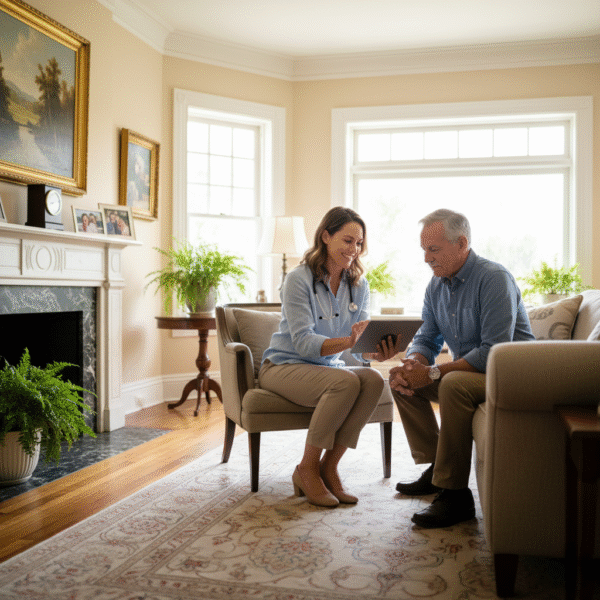
A female doctor meeting with an older man in a bright Pasadena living room, reviewing information together on a digital tablet.
AI-generated image for illustrative purposes only.

Practical Visitor Information

Address

391 South Orange Grove Boulevard, Pasadena, CA 91184

Gardens

Open daily, free admission.

House Tours

Free guided tours are typically offered Thursdays at 2 PM (seasonal, February to August). Pre-registration is required.

Parking

Available on adjacent streets (e.g., Arbor St.), but not on Orange Grove Blvd itself.