This article is for informational purposes only and does not constitute medical advice, diagnosis, or treatment. Always seek the advice of your physician or other qualified health provider with any questions you may have regarding a medical condition. If you think you may have a medical emergency, call your doctor or 911 immediately.
Huntington Hospital is the main hospital in Pasadena, now known as Huntington Health, an affiliate of Cedars-Sinai. It sits at 100 W California Blvd and serves the whole San Gabriel Valley. This overview breaks down what the hospital does, its emergency room, and the clinics that handle everyday care.
Many locals still call it Huntington Hospital or Huntington Memorial Hospital. Whatever name you use, it is the same nonprofit medical center that has anchored care in Pasadena for well over a century.
If you are new to the area or helping an older parent find care, it helps to know how the pieces fit. The hospital, its emergency room, and its network of clinics each play a different role.
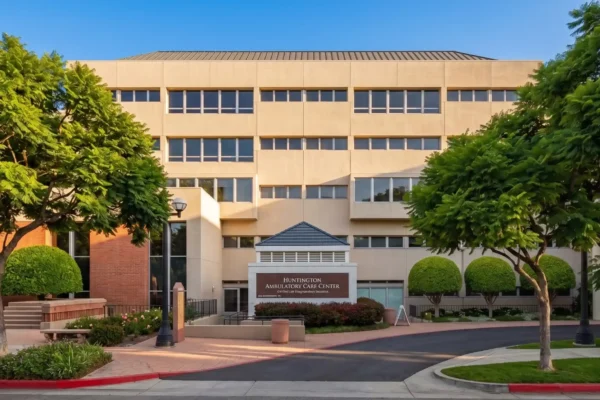
A Regional Hospital in the Heart of Pasadena
In 2021, the hospital became an affiliate of Cedars-Sinai. That link gives local patients easier access to specialty referrals, research, and clinical trials, while care stays right here in the San Gabriel Valley.
As a nonprofit, the hospital also reinvests in the community. It runs training programs for new doctors and puts millions each year back into local health and education efforts.
That long history shows up in day-to-day trust. For many Pasadena families, Huntington is simply where you go, whether for a birth, a surgery, or a late-night emergency.
The Emergency Room and Trauma Center
A trauma center designation matters for serious injuries. It means a team trained for major emergencies, from car crashes to severe falls, is ready around the clock.
Being the only such center in the San Gabriel Valley also means it draws serious cases from across the region. That volume builds real experience, which is exactly what you want in a crisis.
For a true emergency, this is where an ambulance in the area will usually go. For smaller problems, a clinic or primary care visit is often the faster, calmer route.
Being the region’s busiest ER also means wait times can climb during peak hours. Life-threatening cases are seen first, so a minor issue may sit longer than it would elsewhere.
ER, Urgent Care, or a Clinic: Where to Go
Urgent care fits the middle ground, like a sprain, a mild cut, or a fever that will not break. It is quicker and cheaper than the ER for problems that still cannot wait for an appointment.
A primary care clinic is the right place for checkups, ongoing conditions, and most everyday concerns. Starting there, and keeping one doctor who knows you, often prevents small issues from turning into ER trips.
When you are not sure, err toward caution for anything sudden or severe. But for the routine bumps of daily life, a call to your own doctor usually points you in the right direction.
Services and Specialties
- Cancer care, from diagnosis through recovery
- Heart care, including diagnosis, treatment, and cardiac rehab
- Neurology, with a dedicated stroke program
- Surgery, home to the largest robotic surgery program in the San Gabriel Valley
- Maternity and newborn care, including a NICU
- Orthopedics for bones, joints, and sports injuries
- Senior care, through a network serving older adults since 1984
This breadth is what makes it a regional hub. Complex care that once meant a drive into Los Angeles is often available in Pasadena instead.
The Cedars-Sinai tie adds depth to these programs. For a rare cancer or a tricky heart case, doctors can tap specialists and clinical trials through the larger system without sending you far from home.
Maternity is a good example of the everyday side of that care. The hospital delivers babies and runs a newborn intensive care unit, so families with a high-risk pregnancy can stay close to home for both the birth and any extra support a newborn needs.
Care for Older Adults
Older patients often juggle several conditions at once, plus questions about memory, mobility, and medications. Care aimed at seniors tries to look at the whole picture, not just one problem at a time.
For families, that focus can make a hard season easier. Support with planning, recovery, and follow-up helps a loved one get back home and stay steady there.
Clinics and Everyday Care
Specialty offices cover areas like endocrinology, rheumatology, and rehabilitation, while pediatric offices care for kids across the valley. Having these tied to the hospital keeps records and referrals connected.
For routine care, a local family doctor is often the easiest starting point. In Pasadena, Cleo Tsolakoglou-Williams, M.D. is a family medicine physician who handles checkups, everyday illnesses, and ongoing conditions.
A steady relationship with one doctor pays off over time. They learn your history, track changes year to year, and can guide you to the right specialist when you need one.
Some tests can even come to you instead of the other way around. For an X-ray or EKG at home, Gentry Imaging offers mobile imaging across the Pasadena area, which helps people who find travel hard.
Seeing a doctor does not always mean leaving the house either. When getting out is difficult, you can book an in-home doctor visit for routine and follow-up care in the Pasadena area.
These options work well alongside the hospital, not against it. A local doctor can manage the everyday and, when something bigger comes up, point you toward the right specialist or program at Huntington Health.
Visiting Huntington Health
You can look up doctors, clinic locations, parking, and patient information on the hospital’s own site. The Huntington Health website is the best place for current hours, directions, and department details.
Because a hospital this large has many entrances and buildings, it helps to confirm where your appointment is before you go. A quick check saves time on the day.
If you are a patient, the hospital’s online portal lets you view results, message your care team, and manage appointments. Setting it up before a visit makes the whole process smoother.
For visitors, it is worth checking current visiting hours and any entrance rules ahead of time, since these can change. Planning parking in advance also takes the stress out of arriving.