This is for informational purposes only. For medical advice or diagnosis, consult a professional.
Most emergency room visits run a few hours door to door. The clock depends on how sick you are, not on when you walked in.
That one sentence explains almost every frustrating wait. According to the CDC (2025), United States emergency departments handle about 155.4 million visits a year, 40.6% of patients are seen within 15 minutes, and 11.5% of visits end in a hospital admission.
So a long wait usually means two things at once: your problem is not immediately dangerous, and the department is full of people whose problems are. Neither fact makes the afternoon any shorter, but both change what you can do about it. The rest of this page covers how the order is decided, what you can influence, and when another option fits better.
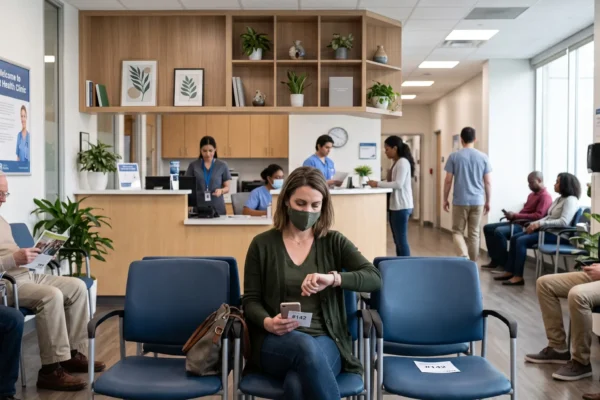
How Long Is the Average Emergency Room Wait Time?
A nationwide study published in Clinical and Experimental Emergency Medicine (2024) looked at more than 25 million emergency visits in Korea and found a median length of stay of 2.1 hours, with 12.6% of patients staying six hours or longer. Patients aged 65 and over, those transferred from another hospital, and those arriving by ambulance were all more likely to have a long stay, and so were people who arrived overnight.
Those patterns travel well even if the exact hours do not, since every emergency system sorts by severity in much the same way. The short version is that most people are out within a few hours, a meaningful minority are there far longer, and age and medical complexity are what separate the two groups.
The Two Clocks Worth Asking About
Why Does the ER Take So Long When You Are Already There?
Triage Decides the Order
This is also why a waiting room can look half empty while nothing seems to move. The beds behind the doors are full, and triage decides who gets the next free bed rather than who has been sitting the longest. What you can see from a plastic chair tells you almost nothing about what is happening on the other side.
Tests and Results Eat the Middle Hours
Boarding Backs Up Everything
Does Arriving by Ambulance Get You Seen Faster?
The study above found the opposite pattern, in fact: patients who arrived by ambulance were somewhat more likely to have a long stay, largely because they tend to be sicker and need more work-up. Calling 911 for a sprain does not buy speed, and it does occupy a crew.
Call 911 when it is genuinely needed, which is also when the crew earns its keep: they start treatment on the way, they alert the hospital before arrival, and for stroke or heart attack that pre-alert is worth more than any place in a queue.
What Time Is the ER Least Busy?
A more useful habit than hunting for a quiet hour is checking what a specific hospital is reporting right now. Many systems publish a live estimate for each of their sites, and a fifteen-minute drive to a less busy campus can save more time than any arrival hour.
Just hold that number loosely. A posted estimate is a snapshot that can change within minutes of a single ambulance arriving, and it only ever describes the first clock. It is never a reason to drive past a closer emergency room with something that might be serious.
What Actually Makes an ER Visit Shorter?
Bring a current list of medicines and doses, allergies, past surgeries, and the name of the regular doctor. Bring the ID and insurance card. If a specialist already knows the problem, bring their name and the date of the last visit. Every one of these answers is something staff would otherwise have to chase.
Be ready to describe when the problem started, what makes it worse, and what you have already tried. Vague histories lead to broader testing, and broader testing takes longer. A clear story often narrows the work-up to one or two tests.
Picking the right building matters just as much. A small community ER and a large trauma center run at different speeds and handle different problems, which is why it helps to know which Pasadena hospitals have an emergency room before an evening when you need one.
Is It Normal to Wait 4 Hours in the ER?
What is not normal is feeling worse while you wait and keeping it to yourself. New chest pain, worsening shortness of breath, a change in alertness, or pain that climbs sharply should all be reported at the desk straight away. Triage levels get revised, and that is what the reassessment exists for.
Ask for a reassessment rather than an update. The two requests sound almost the same and get very different responses, because one is a question about timing and the other is a clinical request that a nurse has to act on. Use the word if something has genuinely changed since triage.
When Is Urgent Care the Better Choice?
Emergency care is for severe shortness of breath, chest pain or signs of a heart attack, signs of a stroke, major injuries, seizures, uncontrolled bleeding, severe allergic reactions, serious head injuries, and sudden severe pain. Those are not wait-and-see problems and not urgent care problems.
Urgent care handles common viral illness, cuts that need stitches, ear infections, pink eye, possible sprains and simple fractures, sinus infections, rashes, sore throats, and urinary tract infections. Pasadena has several options, and the local walk-in clinics and urgent care sites differ in what they keep on site, especially imaging.
Cost is part of the picture too. MedlinePlus (2024) notes that treatment in an emergency department can cost two to three times more than the same care in a provider’s office, with higher copayments on most plans. That gap is one more reason the match between problem and place is worth getting right.
| Where You Go | What It Is Built For |
|---|---|
| Emergency department | Anything that could be life-threatening or disabling; open around the clock; order set by triage, not arrival |
| Urgent care or walk-in clinic | Problems that need care within hours: minor injuries, infections, rashes, simple fractures |
| Your own doctor, in person or by phone | Ongoing conditions, medicine questions, and symptoms that have been building for days |
| A visit at home | Non-emergency problems in someone who is frail or hard to transport, when an exam is the main thing needed |
What Else Can Replace an Emergency Room Trip?
A doctor who comes to the house can examine the person, look at the medicine list, and say whether this needs a hospital. That is a narrower job than the emergency department does, and it only fits problems that are not urgent, but it fits them well.
The same sorting question comes up whenever symptoms build slowly after an event and nobody is sure what counts as an emergency. Local guidance on which symptoms after wildfire smoke can wait is a good example of that judgment in practice, and it is the same judgment that fills waiting rooms every evening.
Sources Used
- After a Wildfire: Which Smoke Inhalation Symptoms Can Wait and Which Can’t – Doctor2me Pasadena
- Emergency Department Visits – Centers for Disease Control and Prevention (2025)
- ER Near Me in Pasadena: Which Hospital Has an Emergency Room? – Doctor2me Pasadena
- Exer Urgent Care – Four Pasadena Locations – Doctor2me Pasadena
- Factors that predict emergency department length of stay in analysis of national data – Clinical and Experimental Emergency Medicine (2024)
- Urgent Care vs. the ER: How To Choose Where To Go – Cleveland Clinic (2026)
- What a Walk-In Clinic in Pasadena Can and Can’t Do – Doctor2me Pasadena
- When to use the emergency room – adult – MedlinePlus (2024)
Frequently Asked Questions
Can you be turned away from an emergency room for not having insurance?
No. Hospital emergency departments that take part in Medicare must screen anyone who comes in, and must stabilize an emergency condition regardless of ability to pay. Billing comes afterward and can be discussed with the hospital’s financial counselors.
Should someone wait with the patient the whole time?
Where allowed, yes, especially for an older adult. A second person remembers what was said, notices a change sooner, and can go back to the desk. Policies on visitors vary, so ask at check-in rather than assuming.
What happens if you leave before being seen?
You can leave at any point, and staff will usually ask you to sign a form. The risk is that the problem you came in with has not been assessed by anyone. Tell the desk you are leaving rather than slipping out, so the record is accurate.
Does the online wait time a hospital posts include test results?
Usually not. Most posted figures estimate time until a clinician first sees you. The rest of the visit, including blood work and imaging, sits outside that number entirely.
Is a freestanding emergency room the same as a hospital ER?
It provides emergency-level care but is not attached to a hospital, so anyone needing admission has to be transferred. Costs are billed at emergency rates. For a problem likely to end in admission, a hospital-based department avoids a second move.
What should you bring for an older adult with memory problems?
Their medicine list, a one-page summary of their usual baseline, hearing aids and glasses, and a familiar item or two. Staff cannot tell new confusion from their normal state without someone to describe the baseline.