This is for informational purposes only. For medical advice or diagnosis, consult a professional.
A fall risk assessment has two halves: short tests of balance and leg strength, and a walk through the house looking for what caused the near misses.
Both halves matter, and the home half has the better evidence behind it. According to MedlinePlus (2024), about a third of older adults living at home in the United States fall at least once a year, and about half of people living in nursing homes do.
Families usually call after the second or third fall, with two fears running underneath. One is that a bad fall is coming. The other is the one nobody says out loud: that it happens when nobody is home and they cannot get up.
What Does a Fall Risk Assessment Actually Involve?
The Questions That Start It
Answer them accurately rather than bravely. Underreporting falls is the single most common reason a preventable fall happens later, and a clinician has no way to correct for an answer that was softened to avoid worrying the family.
The Tests You Can Expect
Each one produces a number, and the numbers are what make the second visit meaningful. The table below sets out what each test measures and the thresholds published for it.
| Test | What it measures and what the number means |
|---|---|
| Timed Up and Go | Walking and turning; 12 seconds or more may indicate higher fall risk |
| 30-Second Chair Stand | Leg strength and endurance; a lower count may indicate higher risk, with the threshold varying by age |
| 4-Stage Balance Test | Four standing positions held 10 seconds each; trouble at position 2 or 3, or under 5 seconds on one leg, may indicate higher risk |
| Berg Balance Scale | 14 scored tasks out of 56 points; a lower total indicates higher fall risk |
| Orthostatic blood pressure | Blood pressure lying and standing; a large drop on standing points to a treatable cause |
Numbers from these tests also give you a baseline. Repeating them after three months of exercise is the only honest way to tell whether the program is working.
What Is the Berg Balance Scale Test?
A 2024 review in PubMed Central describes it as 14 items, each scored from 0 to 4, for a maximum of 56 points, taking about 20 minutes to complete, with a lower score indicating higher fall risk. The items are ordinary movements: standing up, reaching forward, turning around, stepping onto a stool.
The length is the point. A quick screen tells you there is a problem, and a Berg score tells a therapist which specific movements are failing, which is what a treatment plan is built from.
Does Fixing the Home Actually Reduce Falls?
Those numbers describe assessment plus changes, not assessment alone. Someone has to walk through the house, name the hazards, and then the hazards have to be removed. A list on the fridge does nothing.
Worth noting from the same review: reported fall-related injury events rose slightly, which the authors attribute to better monitoring and reporting rather than more injuries. Families who start paying attention find falls they used to miss.
What Does a Room-by-Room Home Safety Audit Cover?
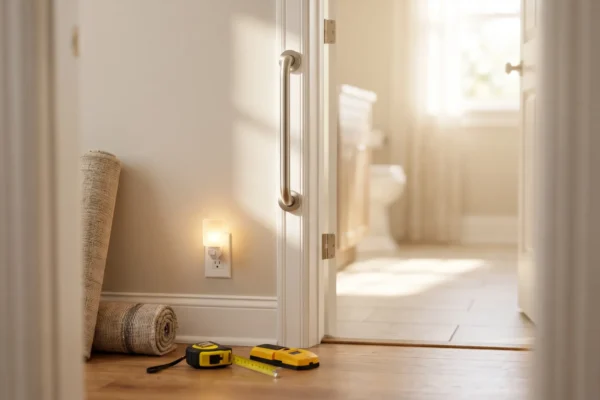
The Bathroom
Towel racks are not grab bars. Many falls happen when someone reaches for a rack that comes off the wall with them.
The Bedroom and the Route to It
Keep the path clear and keep it the same. People navigate familiar routes partly from memory, so rearranging furniture creates new hazards.
Floors, Stairs and Cords
This is also where equipment decisions belong. Call Before You Fall does free in-home assessments and sources the equipment that follows, choosing between grab bars, ramps, and stair or chair lifts based on the home’s layout, the family’s needs, and what the person’s prognosis suggests they will need next year rather than only today.
Which Medical Causes Make Someone Fall Twice a Week?
Medicines and Blood Pressure
Dizziness and the Inner Ear
Bones, Vision and Feet
Vision matters in a way people underestimate. New bifocals change depth perception on stairs, and an outdated prescription or an untreated cataract makes a dim hallway genuinely dangerous. Feet come last on every list and cause plenty of falls: numbness, pain, deformed toes, and worn-out shoes all change how someone walks.
After a stroke, balance and attention can both be affected at once, which multiplies the risk. Our article on memory loss after stroke covers what changes in the months afterward and what should be reassessed.
What About the Fear of Falling Itself?
The social cost is measurable. A 2025 nationwide longitudinal panel study of 8,632 adults aged 60 and older found that people with fear of falling were less likely to take part in formal social activity, with an odds ratio of 0.77 in men and 0.84 in women, and that those with both fear of falling and activity restriction were less likely still, at 0.53 in men and 0.72 in women.
Practical Answers to the Fear of Not Getting Up
For a household where someone is alone for long stretches, paid help may be the honest answer. Our checklist on hiring a caregiver in Pasadena covers what to verify before signing anything.
What Happens Right After a Fall?
If the emergency room is where you end up, knowing the shape of the night helps. Our piece on ER wait times and how long a visit really takes sets out what happens between triage and discharge.
Recovery is where the next fall is prevented or baked in. Physical therapy at home after a fall rebuilds the strength and confidence that the fall took away, and 911 AM PM Home Health covers what in-home physical therapy does after a parent falls in detail, including how balance work is structured.
How Do You Set Up an Assessment in Pasadena?
If there is no current primary care relationship, that is the first gap to close, and our guide to finding a doctor accepting new patients in Pasadena covers how to do it without a long wait.
Why an At-Home Assessment Finds More
Bring three things to that appointment: every medicine container in the house, a short written list of the falls and near misses with dates, and the shoes the person wears every day. Those three turn a general conversation into a specific plan.
Frequently Asked Questions
How often should a fall risk assessment be repeated?
Yearly is the usual rhythm for an older adult with no recent falls, and sooner after any fall, any new medicine, or any hospital stay. A change in walking or a new fear of stairs is also a reason to repeat it rather than wait for the anniversary.
Does Medicare pay for this kind of assessment?
Fall risk screening is a standard part of the annual wellness visit, so for many people it is already included. Coverage for therapy, equipment, and home modifications works differently, and equipment often is not covered at all. Confirm specifics with the plan before ordering anything.
Can a family member do the home safety check instead of a professional?
A family member can catch most of the obvious hazards, and doing that is far better than doing nothing. A trained assessor tends to notice the things families walk past daily, such as a step height that varies or a handrail that ends before the last stair.
Are grab bars something a handyman can install?
Installation matters more than the bar. A grab bar has to be anchored into structure rather than into drywall or tile alone, and suction-cup bars are not a substitute. Whoever installs it should be able to say what it is anchored to.
Do balance exercises work if someone is already very frail?
Often yes, with supervision and a lower starting point. A therapist adjusts the program to what the person can do safely, sometimes beginning with seated work. Frailty is a reason to get guidance rather than a reason to skip exercise.
What if a parent refuses the whole conversation?
Start with one change rather than a plan. A night light, a pair of non-slip socks, or one grab bar is easier to accept than a safety overhaul, and it keeps the subject open. Framing it around staying at home longer usually lands better than framing it around risk.
Sources Used
Effectiveness of Home Hazard Assessment and Environmental Modification on Fall-Related Outcomes in Older Adults: A Systematic Review and Meta-analysis – Journal of Community Health (2026)
Fall Risk Assessment – MedlinePlus, National Library of Medicine (2024)
Impact of fear of falling on social engagement among older adults: A nationwide longitudinal panel study – PubMed Central, National Library of Medicine (2025)
My Parent Fell at Home. Can In-Home Physical Therapy Help? – 911 AM PM Home Health Care
Outcome Measurement in Balance Problems: Berg Balance Scale – PubMed Central, National Library of Medicine (2024)
Fall Prevention at Home: Room-by-Room Safety Guide – InjuriesPrevention
Medicines that increase fall risk in older adults – Mayo Clinic (2025)