This is for informational purposes only. For medical advice or diagnosis, consult a professional.
Memory loss after stroke is common, and much of it improves. Thinking, movement and speech often get better over the first weeks and months, sometimes for years.
What families want to know within days of a hospital discharge is which changes are part of recovery and which are the start of something that will keep getting worse. The honest answer is that the direction of travel over the following months tells you more than any single week.
Knowing what each pattern looks like makes the difference between watching anxiously and watching usefully.
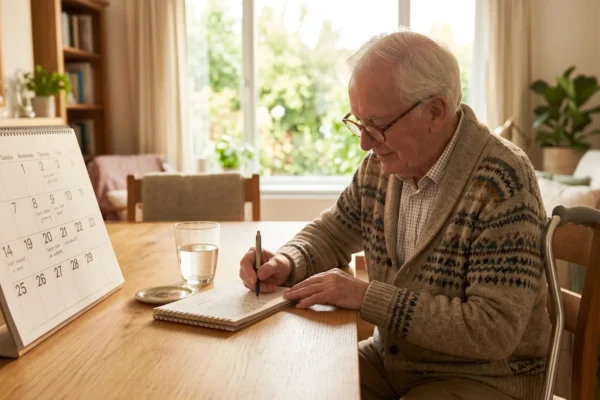
Is Memory Loss After Stroke Normal?
MedlinePlus (2025) lists changes in thinking and reasoning, memory problems, poor judgment and changes in behavior and sleep among the usual effects after a stroke. Families often notice the memory and attention problems after the physical ones, because walking and speech get attention first.
Depression is also common and easy to mistake for cognitive decline. It can start soon after the stroke, or symptoms may not appear for up to two years. Someone who seems blank, slow and uninterested may be depressed rather than losing memory, and that difference changes what helps.
What Causes Post Stroke Cognitive Impairment?
Scale matters. A large stroke in a region that handles memory causes obvious problems straight away. Small strokes in deep brain tissue can pass without any noticeable event, and their effect shows up only as a gradual change in how someone thinks.
The numbers explain why so many families face this. CDC (2024) reports that more than 795,000 people in the United States have a stroke each year, and about 185,000 of those, nearly one in four, happen to someone who has had a stroke before.
How Much Memory Comes Back, and How Long Does It Take?
The First Weeks and Months
The Longer Tail
What Does Vascular Dementia After Stroke Look Like?
First Signs of Vascular Dementia
- Getting lost on roads they have driven for decades
- Losing the names of familiar objects and reaching for the wrong word
- Misplacing items, then becoming convinced someone moved them
- Losing interest in hobbies and people, with a flat mood
- Personality change and loss of the usual social filters
- Mood swings that tip into anger or aggression
Not every item on that list means dementia. Several of them appearing together, and staying, is what moves the question from recovery to diagnosis.
Why the Decline Looks Like Steps, Not a Slope
Cleveland Clinic (2025) notes that about 5% to 10% of people with dementia have vascular dementia alone, and that it frequently occurs alongside Alzheimer’s disease, which clinicians call mixed dementia. That overlap is one reason a precise label can take time.
Can a Mini Stroke Cause Memory Loss?
That is the mechanism behind a lot of unexplained decline in older adults. Each event on its own is too small to notice, and the combined effect eventually crosses the line into obvious memory trouble. Brain imaging frequently shows evidence of strokes nobody knew about.
A transient episode with weakness, slurred speech or vision loss that resolves within an hour still needs emergency assessment. It is a warning that a larger stroke may follow, and the window for preventing one is short.
Personality Changes, Suspicion and Paranoia After a Stroke
Accusations are common and painful. Someone who cannot remember where they put a wallet may conclude that it was taken, and arguing the point rarely works. Responding to the worry rather than the accusation usually settles things faster than proving a fact.
Sudden confusion is a different matter and needs attention the same day. A change that appears over hours, especially with an infection or a recent medication change, often turns out to be delirium rather than dementia, and this comparison of delirium and dementia in older adults explains how the two differ.
What Therapy for Memory Loss After Stroke Involves
| Type of Therapy | What It Works On |
|---|---|
| Speech and language therapy | Word finding, understanding, reading and writing, and safe swallowing |
| Occupational therapy | Dressing, cooking, managing money and routines, and home adaptations |
| Physical therapy | Strength, balance, walking and safe use of canes, walkers or wheelchairs |
| Neuropsychological testing | Mapping which parts of thinking are affected, to guide the rest of the plan |
The home setting is assessed too. Stairs, loose rugs, bathroom access and the risk of wandering all get looked at, because a safe layout allows more independence rather than less. Counseling for the family is part of the standard offer and is often the piece that gets skipped.
Recovery Patterns Versus Patterns That Need a Neurologist
A different pattern is worth raising with the neurology team at the next appointment. Thinking that was improving and then clearly drops. New confusion that was not there last month. Getting lost somewhere familiar for the first time. Trouble working the phone or the TV remote that was fine before.
Age Alone Does Not Explain It
Several reversible things can mimic decline, including thyroid problems, vitamin deficiency, infection, depression and medication effects. Testing for those is routine, and finding one is good news.
Where the Practical Help Comes From at Home
Home health agencies cover that ground. 911 AM PM Home Health care provides skilled nursing along with physical, occupational and speech therapy across Los Angeles and neighboring counties, which is the combination most stroke recoveries need.
Getting a physician’s review without a car journey is possible too. A doctor who visits at home can assess cognition, review medicines and check blood pressure in the setting where the problems actually show up, which often tells more than a fifteen-minute clinic appointment.
What Pasadena Families Can Line Up Next
Then sort out who is in the medical picture. If a primary care doctor retired or moved during the hospital stay, this guide on finding a doctor accepting new patients in Pasadena covers the local options. Knowing what an emergency room visit really involves is also worth reading before you need it.
Care at home may eventually need more hands. Our guide to hiring a caregiver in Pasadena covers what to verify before signing anything, and if the conversation turns to a move later on, the comparison of memory care and assisted living for Pasadena families lays out the differences.
Frequently Asked Questions
Does a stroke on one side of the brain affect memory differently?
It can. Left-sided strokes more often disturb language and verbal memory, while right-sided strokes tend to affect attention, spatial awareness and recognizing faces or places. Rehabilitation plans are shaped around which side was involved.
Can blood pressure control slow further decline?
Managing blood pressure, diabetes, cholesterol and heart rhythm is the main way to reduce the risk of more strokes, and fewer strokes means less additional brain damage. These targets are set individually by a physician.
Is memory testing worth doing if the diagnosis is already clear?
Often yes. Neuropsychological testing maps which specific abilities are affected and which are intact, which helps therapists target their work and gives families a realistic picture of what support is needed.
Can someone with post-stroke memory loss still drive?
That depends on reaction time, attention, vision and judgment rather than memory alone, and it is assessed formally rather than guessed at. Occupational therapists and state licensing rules both play a part in the decision.
Does sleep affect memory recovery after a stroke?
Poor sleep makes attention and memory noticeably worse, and sleep patterns often change after a stroke. Raising it with the medical team is worthwhile, since treating a sleep problem sometimes improves daytime thinking considerably.
How do we handle repeated questions without losing patience?
Short answers, a visible calendar and a written daily plan reduce the number of questions more than correcting does. Family counseling is part of standard stroke care and can help everyone adjust to the new routine.
Sources Used
Recovering after stroke – MedlinePlus Medical Encyclopedia (2025)
Stroke Facts – Centers for Disease Control and Prevention (2024)
Vascular dementia – MedlinePlus Medical Encyclopedia (2025)
Vascular Dementia – Cleveland Clinic (2025)
Memory Loss – American Stroke Association (2024)
Silent Stroke: Symptoms, Causes, and Why it Matters – Baystate Health (2026)
Behaviour changes after a stroke – Stroke Association (2026)