This is for informational purposes only. For medical advice or diagnosis, consult a professional.
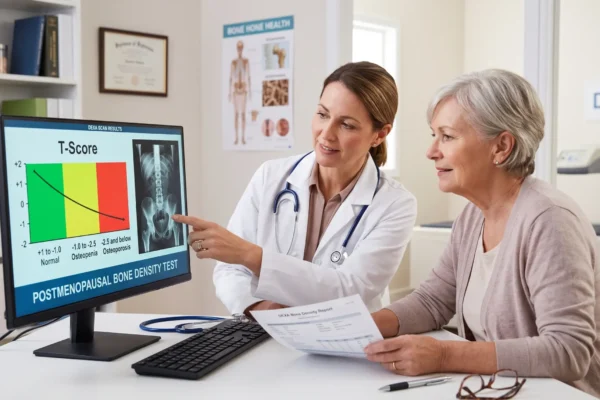
A DEXA scan measures bone density and gives you one number, the T-score. Minus 1.0 or above is normal. Minus 2.5 or below means osteoporosis.
The number in between is where most of the confusion lives, and where most of the useful action happens. MedlinePlus (2025) puts bone loss, also called osteopenia, at a T-score of -1.1 to -2.4, and osteoporosis at -2.5 or below.
The second piece of confusion is timing. Waiting until 65 is not the rule for everyone, and the current national screening advice says so plainly. The sections below cover what the scan does, how to read the result, who should be tested earlier, and what to do with a number you do not like.
What Does a DEXA Scan Actually Measure?
What Happens During the Scan
It is short and painless. The same page gives the usual length as 10 to 30 minutes, with results typically back within a few days. A peripheral scan of the wrist, hand, or foot takes only a few minutes, but it tells you less.
Central Versus Peripheral Scans
Two practical points before you go. Remove metal items, and skip calcium supplements for 24 hours beforehand, because a supplement sitting in your gut can throw the reading off. Tell the technologist if you are or could be pregnant.
How Do You Read a T-Score?
Those three bands are the whole vocabulary, and knowing them means you can read your own report before anyone explains it. The table below sets out the ranges as MedlinePlus (2025) gives them, so you can find where your own number sits.
| T-score | What it means |
|---|---|
| -1.0 or above | Normal bone density. Repeat testing is based on your risk factors and your doctor's advice rather than on a fixed schedule. |
| -1.1 to -2.4 | Bone loss, often called osteopenia. Not a diagnosis of osteoporosis, and the range where diet, exercise, and risk-factor changes do the most good. |
| -2.5 or below | Osteoporosis is likely. This is the range where a doctor will usually discuss prescription treatment alongside everything else. |
One number is less useful than two. A score that has moved from -1.4 to -2.0 over four years tells your doctor something a single reading cannot, which is why keeping copies of your reports is worth the drawer space.
Why Your Score Is Not Your Fracture Risk
That is also why asking for a formal fracture risk assessment is reasonable. It combines the scan with your history into an estimate of what might happen over the next ten years, which is a far more useful basis for a decision than one number alone.
Who Should Get a DEXA Scan Before 65?
The U.S. Preventive Services Task Force (2025) recommends screening for osteoporosis in women 65 years or older, and also recommends screening postmenopausal women younger than 65 who are at increased risk of an osteoporotic fracture as estimated by clinical risk assessment. Both carry a B grade.
The Risk Factors That Move the Date Earlier
Early menopause deserves its own mention, because it is the one patients rarely raise themselves. Menopause before the usual age means more years without estrogen’s protective effect on bone, and that is a reason to ask about a scan rather than wait.
A well-woman visit is the natural place to raise it, because the clinician already has your menopause history in front of them. Our round-up of women’s health clinics in Pasadena covers what those visits usually include and how they differ from a general checkup.
What About Men?
MedlinePlus (2025) notes the same disagreement in practice: some groups recommend testing men at age 70, while others say the evidence is unclear. A man with a previous fracture, long-term steroid use, or a strong family history is still worth a conversation.
Why Do Doctors Sometimes Not Order It Early?
That gives you a practical script. Say your age at menopause, any fracture after 50, any parent with a hip fracture, your smoking and drinking history, and any steroid treatment you have had. Those are the exact inputs a risk assessment uses.
Bringing it up as a question about risk rather than a request for a test usually lands better. A doctor weighing whether to order a scan is looking for the risk factors, and you are the only person in the room who knows all of them.
What Are the Symptoms of Osteoporosis?
Some changes do show up over time. Losing height, a gradual stoop, or back pain that appears without an injury can all point toward spinal fractures that happened quietly. None of these is proof, and each is worth mentioning.
The timeline underneath is slow and silent. The NIH Office of Dietary Supplements (2023) notes that bones slowly lose calcium after about age 30, and that in middle age this loss speeds up and can lead to weak, fragile bones and broken bones.
What Can You Do About Osteopenia?
Calcium: How Much, and From Where
There is such a thing as too much. The same fact sheet sets the upper limit, counting food, drinks and supplements together, at 2,500 mg a day for adults 19 to 50 and 2,000 mg a day from 51 onward, and notes that some research suggests high calcium intakes might raise the risk of heart disease and prostate cancer.
The evidence on supplements is more mixed than the label suggests. The fact sheet reports that some studies found calcium supplements, with or without vitamin D, increase bone mineral density in older adults while others did not, and that whether they prevent fractures is unclear. Food first is a reasonable default.
Movement That Loads the Bone
Balance is the other half of the equation, because a fracture needs a fall as well as thin bone. DizzyCare Physical Therapy works on vestibular rehabilitation across Pasadena, Arcadia, Sierra Madre and nearby areas, which is the relevant kind of help when dizziness is part of why someone is unsteady.
Our piece on simple habits that keep bones strong covers the everyday version of all of this, and the one on fall risk assessment for seniors explains what a formal balance check involves and who carries it out. Doing both is more useful than doing either one alone.
How Is Osteoporosis Treated?
What is worth knowing in advance is the shape of the plan. Most approaches aim to slow bone loss or support bone building, are reviewed after a set period, and are usually paired with adequate calcium and vitamin D so the treatment has the raw material to work with.
Who to See About the Result
If getting to an appointment is the obstacle, an assessment can also happen at home. A doctor who visits at home can review medications, check balance, and order tests without anyone having to manage a parking garage on a bad day.
What Does a DEXA Scan Cost?
Three questions settle it before you book. Ask whether the scan is billed as screening or as diagnostic, whether the imaging center is in your plan’s network, and what the plan requires in the way of a referral or prior authorization.
Searching for a DEXA scan near you is worth doing by facility rather than by price alone. A center that does central DEXA on the hip and spine gives a more useful result than one offering only a wrist or heel measurement, and repeat scans are best done on the same machine.
How Often Should the Scan Be Repeated?
Consistency matters more than frequency. Repeating the scan at the same facility, and on the same machine where possible, makes the comparison meaningful, because small differences between machines can look like real change when nothing has actually changed.
Keep your own copy of each report with the T-score written on it. Bringing the previous number to the next appointment is the single easiest thing a patient can do to make the follow-up visit useful, and it also covers you if you change doctors.
Frequently Asked Questions
Can a DEXA scan be wrong?
It can be misleading rather than wrong. Severe spinal arthritis, previous spine surgery, or metal implants can raise the reading at that site, so your doctor may rely more on the hip result.
Can a DEXA scan be wrong?
It can be misleading rather than wrong. Severe spinal arthritis, previous spine surgery, or metal implants can raise the reading at that site, so your doctor may rely more on the hip result.
Is a Z-score the same thing as a T-score?
No. A Z-score compares you with people your own age rather than with a young adult, and it is used mainly for younger adults, premenopausal women, and children.
Should I stop my calcium supplement before the scan?
Skip it for 24 hours beforehand, as MedlinePlus advises, because a supplement passing through the gut can affect the reading. Resume it afterward unless your doctor says otherwise.
Do I need a specialist, or can my primary care doctor order this?
A primary care doctor can order the scan and interpret a straightforward result. A specialist is more useful when the result is unexpected, when other hormone problems are in play, or when treatment decisions are complicated.
Does losing weight affect bone density?
It can, because lower body weight is itself a risk factor for low bone density. Mention any significant unintentional weight loss when you discuss screening, since it may change the timing.
Sources Used
Bone mineral density test – MedlinePlus (2025)
Calcium – NIH Office of Dietary Supplements (2023)
Osteoporosis to Prevent Fractures: Screening – U.S. Preventive Services Task Force (2025)