This is for informational purposes only. For medical advice or diagnosis, consult a professional.
If you have searched “MRI near me” in Pasadena, you have options close by. Two well-known outpatient centers, Imaging Specialists of Pasadena and Madison Radiology Advanced Imaging, both offer MRI, and each has its own strengths. Below is a simple guide to where to go, what an MRI is like, what it may cost, and how to get ready.
An MRI is a common test, and getting one does not have to feel confusing. A little planning helps you pick the right place and walk in knowing what to expect. The two Pasadena centers below are a good starting point, but the same questions apply anywhere you go.
What Is an MRI, and What Can It Show?
MRI is best at showing soft tissues. The Radiological Society of North America notes it can look closely at the brain, spine, organs, blood vessels, and joints. That is why a doctor may order one when an X-ray does not tell the whole story.
That makes it a go-to test for many joint and nerve problems. If you are dealing with a bad knee, for example, our guide on worn knee cartilage explains how imaging helps sort out what is going on.
Doctors also use MRI to check the abdomen and pelvis, to look at blood vessels, and to follow a condition over time. Because it skips radiation, it can be repeated when a doctor needs to track changes.
Where Can You Get an MRI in Pasadena?
Imaging Specialists of Pasadena
One draw here is the schedule. The center keeps long weekday hours, which can make it easier to fit a scan around work or family. It is also close to the freeways, so it is simple to reach from much of the San Gabriel Valley.
Madison Radiology Advanced Imaging
A key difference is that Madison offers open MRI. That option can be a relief if a standard, enclosed scanner makes you uneasy. Its central location can also be handy if you live or work near downtown Pasadena.
These are not the only choices in town. Huntington Hill Imaging is another Pasadena center worth a look if you want to compare a few before you book.
Open MRI vs. Closed MRI: What Is the Difference?
Open MRI can help if you feel closed in easily or if a standard scanner is a tight fit. It is a common reason people look for a center that has one. Some newer closed scanners also have a wider opening, which can feel less snug.
There is a trade-off to know about. As the How to Prepare for Your MRI guide points out, open MRI is not available for every type of exam, so ask whether it works for the scan your doctor ordered.
How Much Does an MRI Cost?
In general, an outpatient imaging center can cost less than the same scan done at a hospital. That is one reason many people compare a few centers before booking. The same scan can carry very different charges from one place to the next.
Contrast adds to the price when it is used, and so does scanning more than one body part. Knowing exactly what your doctor ordered helps you get an accurate quote.
A smart move is to ask each center for its price up front, including a self-pay or cash rate if you do not plan to use insurance. Ask whether the quote covers both the scan and the radiologist reading. Some centers offer a discount when you pay at the time of service, so it never hurts to ask.
If you have coverage, check with your plan about what it pays and whether you need prior approval. A quick call can save you a surprise bill later. Many centers will also help you check your benefits before the scan.
Do You Need a Referral for an MRI?
Your primary care doctor is a good first stop. A Pasadena family physician like Cleo Tsolakoglou-Williams, M.D., can review your symptoms, decide if a scan makes sense, and send the order to the center you choose.
If getting to an office is hard, you still have options. A doctor can visit you at home to talk through your symptoms and write the order, so the scan is the only trip you need to make.
A referral also helps the center prepare. It tells them which body part to scan and whether contrast is likely, so your visit runs smoothly.
How Do You Prepare for an MRI?
Tell the staff about any implants or devices before your visit. Pacemakers, certain aneurysm clips, cochlear implants, and older devices matter, and the team needs the exact type to keep you safe.
Also mention metal fragments, such as shrapnel or shavings near the eyes, and any tattoos, which can rarely warm up. Most orthopedic hardware, like joint replacements, is fine, but the team should still know. If there is any doubt about metal in your body, a quick X-ray can check before the scan.
Eating rules vary by center and by scan. Unless your doctor says otherwise, take your usual medicines and eat as normal, and ask the center for its specific instructions. Wearing comfortable clothing without metal zippers or snaps can save time at check-in.
What Is the Scan Like, and Is It Safe?
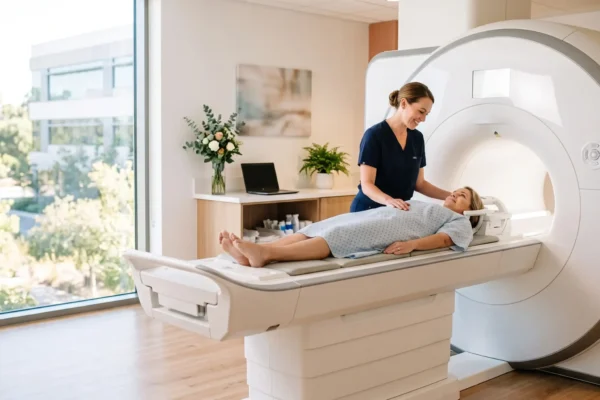
You lie on a table that slides into the scanner. Most scans take about 30 to 60 minutes, and you need to hold still so the pictures come out clear. Staying relaxed and breathing normally makes the time pass more easily.
The machine is loud, with knocking and tapping sounds, so you will get earplugs or headphones. You can talk to the technologist the whole time and hold a call button. It is normal for the scanned area to feel a little warm. Many centers let you listen to music to help pass the time.
Some scans use a contrast dye through an IV to make certain tissues stand out. It is generally safe, and serious reactions are rare, but tell the team if you have allergies or kidney problems. A brief metallic taste after the dye is normal and passes quickly.
If tight spaces make you anxious, say so ahead of time. Your doctor can suggest a mild sedative, and if you take one, arrange for a ride home.
Can Imaging Come to You at Home?
For people who are homebound, some basic imaging can travel. A mobile service like Gentry Imaging can bring X-ray and EKG to the home, which helps when leaving the house is a real challenge.
When an MRI is truly needed, planning transportation ahead of time makes the trip easier. A short bit of prep can take the stress out of scan day.
After the scan, a radiologist reviews your images and sends a report to the doctor who ordered it. From there, your doctor walks you through what the results mean and any next steps.
Frequently Asked Questions
Is an MRI or a CT scan better for my problem?
It depends on what your doctor is looking for. MRI is often better for soft tissues like the brain, spine, and joints and uses no radiation, while CT is faster and better for bone and some emergencies. Your doctor picks the test that fits your case.
Why is an MRI machine so loud?
The loud knocking and tapping come from the scanner coils switching on and off as they make the images. It is normal, and the center gives you earplugs or headphones to protect your hearing.
Can I have an MRI if I have a pacemaker or metal implant?
Sometimes. Many newer devices are approved for MRI, but the team needs the exact make and model to follow the right steps. A few implants are not safe to scan, so always share your device details before the exam.
How long does it take to get MRI results?
A radiologist reviews the images and sends a report to the doctor who ordered the scan, which can take up to a few days. Many centers also post the report to your patient portal.
Can I eat before an MRI?
For most scans, yes. Eating and drinking rules vary by exam and facility, so follow any instructions the center gives you, and take your regular medicines unless told otherwise.
How do I find the cheapest MRI near me?
Call a few outpatient centers and ask for the price of your specific scan, including a self-pay rate. Outpatient centers often cost less than hospitals, and confirming coverage with your insurer helps you avoid surprises.