This is for informational purposes only. For medical advice or diagnosis, consult a professional.
Phototherapy uses controlled doses of ultraviolet light to calm stubborn skin conditions. For many people with eczema or psoriasis, it can bring real relief.
It works, but not overnight, and not the same way for everyone. According to the National Psoriasis Foundation (2024), about 60% of patients who did at least two sessions a week over 12 weeks reached clear or almost clear skin, results the study called comparable to many pill and injection treatments.
This guide explains what phototherapy is, how it helps, and what to realistically expect, so you can decide whether it is worth a try with your dermatologist.
What Is Phototherapy for Skin Conditions?
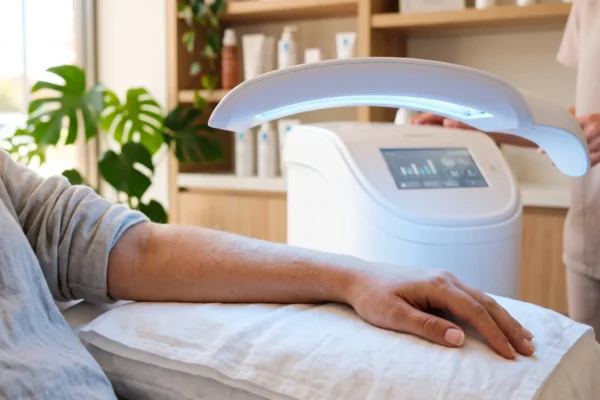
The most common form is narrowband UVB. As the American Academy of Dermatology explains, these UVB rays reach the skin and quiet the overactive immune cells that drive inflammation, which is what eases redness and itch.
Not the Same as a Tanning Bed
Phototherapy is usually offered when creams and ointments have stopped doing enough, but a person wants to avoid or delay stronger, body-wide treatments. It can also pair with other care rather than replacing it.
Getting Started: Your First Phototherapy Visit
At the first visit, the doctor checks your skin, reviews your history, and sets a starting light dose based on your skin type. Lighter skin usually starts at a lower dose to avoid burning.
What a Session Is Like
Come prepared to ask questions. It is fair to ask how many sessions the doctor expects, what results are realistic for your case, and what the plan is if your skin does not respond, so you know what you are signing up for.
How Phototherapy Helps Eczema and Psoriasis
Both conditions are driven by an overactive immune response in the skin.Narrowband UVB works by calming that response where the light lands, which is why it can help two conditions that look and feel quite different.
Psoriasis
Results vary from person to person. Some see patches fade within a couple of weeks, while others need the full course before the skin settles, and a few see only partial improvement.
Where the patches are matters too. Areas like the elbows and knees can be slower to respond than thinner skin, so do not judge the whole treatment by one stubborn spot.
Eczema and Atopic Dermatitis
It tends to help more with the inflammation and itch than with any one patch. Many people notice a difference after a few weeks of steady treatment.
Because eczema flares come and go, phototherapy is often used to break a bad stretch and then ease off. For some, it buys months of calmer skin and better sleep, since less itching at night makes a real difference to daily life.
Types of Light Therapy, Including Blue Light
The table sorts out the main options. Narrowband UVB does most of the work for eczema and psoriasis, while blue light is aimed at a different problem entirely.
| Type of Light Therapy | What It Is Best For |
|---|---|
| Narrowband UVB | The go-to for widespread psoriasis and eczema; a targeted UVB wavelength |
| PUVA (UVA with a light-sensitizing medicine) | Tougher or very widespread cases that need a stronger approach |
| Blue light | Mainly used for acne, not a standard treatment for psoriasis or eczema |
What to Expect: Sessions and Sticking With It
A typical course runs several weeks. The National Psoriasis Foundation describes sessions two to three times a week for roughly six to eight weeks, with each visit lasting only minutes as the light dose is slowly increased.
That schedule is the hard part. Getting to a clinic several times a week around work and life takes real commitment, which is why some people use a prescribed home unit to keep up the routine.
Home or Office Treatment
Either way, a doctor sets the plan and checks your skin along the way. If getting in for those check-ins is hard, some people arrange for a doctor who visits at home to handle the reviews between sessions.
Missing sessions is the most common reason phototherapy underperforms. If your schedule makes two or three clinic visits a week unrealistic, say so early, since a home plan or a different treatment may simply suit your life better.
Managing Side Effects and Protecting Your Skin
Common, Usually Mild Effects
Tell your dermatologist if a session leaves your skin very sore or blistered. The light dose can be adjusted, and a small tweak often fixes it without stopping treatment.
Protecting Your Skin During Treatment
It also helps to go easy on extra sun outside of treatment. Since your skin is already getting a measured dose in the clinic, a sunburn on top of that can undo progress and raise the risk of irritation.
Realistic Results: Remission, Relapse, and Leftover Patches
How Much It Clears
One thing light therapy does not fix is the pale marks left where old patches have healed. Those lighter spots are not active disease, and they usually even out slowly on their own over time.
It is worth setting a rough goal with your dermatologist before you start. Some people aim for fully clear skin, while others are happy with far less itching and fewer visible patches, and both are valid reasons to try it.
Remission and Flare-Ups
Flares can still return, since the underlying condition remains. If that happens, another round of treatment or a maintenance plan can bring things back under control.
Phototherapy for Scalp Psoriasis and Look-Alike Rashes
Because the scalp is hard to reach and easy to irritate, this is an area where a dermatologist’s guidance really pays off. The right tool and technique make the difference between progress and wasted effort.
Getting the Diagnosis Right
A dermatologist can confirm what you are dealing with and set up phototherapy if it fits. In Pasadena, Dr. Ronald Rigor offers phototherapy among other skin treatments, and you can also compare options at a full-service comprehensive dermatology center.
Frequently Asked Questions
Is phototherapy safe for children?
Yes, dermatologists use narrowband UVB for children with moderate-to-severe eczema or psoriasis when creams are not enough. The dose is carefully controlled and adjusted for younger skin, and treatment is always supervised.
Can I just use a tanning bed instead?
No. Tanning beds use a different, mostly UVA wavelength that is less effective for these conditions and raises skin cancer risk. Medical phototherapy uses a precise, prescription UVB light that a tanning bed cannot match.
How soon will I see results?
Many people notice improvement after a few weeks of steady treatment, though some take the full course. If there is no change at all after several weeks, your dermatologist may adjust the plan or try another option.
Does insurance cover phototherapy?
Coverage varies by plan and whether the treatment is in-office or a home unit. It is worth asking your dermatologist’s office to check your benefits before you start, so there are no surprises.
Can I do phototherapy at home?
Sometimes. A dermatologist can prescribe a home unit for the right patients, and research shows it works as well as office treatment. It still needs a doctor’s plan and regular skin checks to stay safe.
Will I need treatment forever?
Not usually in the same intense way. After an initial course, many people move to a lighter maintenance schedule or pause until a flare returns. Your dermatologist tailors the long-term plan to your skin.