This is for informational purposes only. For medical advice or diagnosis, consult a professional.
A new or changing spot on your skin is the most common sign of skin cancer. Most spots turn out to be harmless. But the ones that matter are far easier to treat when caught early, which is exactly why a suspicious spot is worth a closer look.
A spot worth checking might be new, or it might be an old mole that has started to change. It could grow, bleed, crust over, or refuse to heal. Any of those is a good reason to get it looked at.
Here is the reassuring part. Found early, most skin cancers are very treatable. The whole trick is noticing a change and acting on it instead of waiting.
Skin cancer is also the most common cancer in the country. The good news is that it is often visible, which gives you a real chance to catch it yourself between doctor visits.
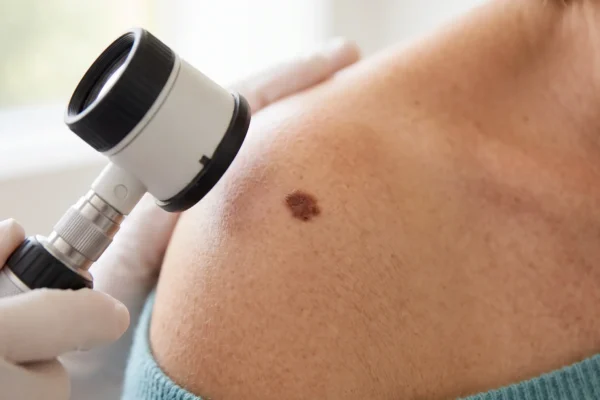
What Does Skin Cancer Look Like?
Basal cell carcinoma can look like a shiny bump, a pink or red scaly patch, or a sore that crusts or bleeds. Squamous cell carcinoma often appears as a firm red or skin-colored bump, a scaly patch, or an open sore. Melanoma is often a mole that changes in size, shape, or color.
Color matters here too. On brown and black skin, these spots can look different and often show up in places the sun rarely reaches, like the palms, soles, or under a nail. Not every red or flushed patch of skin is cancer, but a patch that will not heal still deserves a look.
Most of these spots show up where the sun hits most: the face, ears, scalp, neck, and the backs of the hands. A sore in one of these areas that keeps healing and reopening is a classic warning sign worth taking seriously.
The ABCDE Rule for Moles
- Asymmetry: one half does not match the other
- Border: the edges are jagged or blurry
- Color: the color is uneven or has more than one shade
- Diameter: the spot is larger than a pea
- Evolving: it has changed over recent weeks or months
If a spot lines up with any of these, get it checked. Change over time is the biggest red flag of all.
What Are the Main Types of Skin Cancer?
Basal cell carcinoma is the most common of all. Squamous cell carcinoma is the second most common. Both grow slowly and are usually very treatable when found early.
Melanoma is less common but more serious. It is more likely to spread to other parts of the body. When any cancer spreads like this, doctors call it metastatic, and metastatic melanoma is much harder to treat, which is why early detection matters so much.
Most skin cancers come from the same source: ultraviolet light. Sun exposure and tanning beds both damage the DNA in skin cells over time. A few skin cancers show up on skin that rarely sees the sun, which is why checking all of your skin, not just the sunny parts, is smart.
Knowing the type matters because it shapes the plan. A basal cell cancer and a melanoma are handled very differently. That is one more reason a suspicious spot belongs with a professional rather than a guess at home.
What Is Actinic Keratosis?
It shows up as a rough, dry, scaly patch, often on the face, ears, scalp, or backs of the hands. Because of the texture, it is often easier to feel than to see. Only 5 to 10 percent of these patches turn into squamous cell carcinoma, but most squamous cell cancers start as one, so it is worth treating early.
Who Is at Higher Risk of Skin Cancer?
- Fair skin that burns easily, or blond or red hair and light eyes
- A history of sunburns, especially blistering ones in childhood
- Lots of time in the sun or regular use of tanning beds
- A personal or family history of skin cancer
- Many moles, or a weakened immune system
If several of these fit you, it is worth being extra watchful. More risk does not mean skin cancer is coming, but it does mean regular checks are a good idea.
When Should a Spot Send You to a Dermatologist?
A family doctor is often the first stop. A primary care physician like Cleo Tsolakoglou-Williams, M.D., can look at a spot, weigh your risk, and refer you onward if something needs a closer look.
For that closer look, a dermatologist is the specialist. Dr. Ronald Rigor and other dermatologists can examine a spot, take a sample if needed, and treat it. There are also full dermatology clinics in Pasadena set up for exactly this.
Not sure where to start? A walk-in clinic can handle some things but not others, so a suspicious spot usually belongs with a dermatologist. And if getting to an office is hard, a doctor can come to you for a first look.
Try not to talk yourself out of an appointment. It is easy to assume a spot is nothing, and most of the time it is. But a trained eye can tell the difference in minutes, and that quick check is what turns a scary word into a simple fix.
Do You Need Skin Cancer Screening?
That does not mean you should ignore your skin. Checking yourself regularly helps you catch changes early. Look at the less obvious spots too, like your scalp, your back, and the soles of your feet.
If you are at higher risk, talk with your doctor about how often to be checked. Fair skin, a history of sunburns, lots of past sun, and a family history of skin cancer all raise the odds.
How Is Skin Cancer Diagnosed and Treated?
Treatment depends on the type, size, and location. Many small skin cancers are removed in a quick office procedure. Precancers like actinic keratosis are often frozen off before they can turn into anything worse.
The word cancer sounds frightening, but skin cancer care is often quick and done in an office. Most people go home the same day and heal with a small scar. Early treatment usually means simpler treatment.
What Is Mohs Surgery?
Because it spares as much healthy skin as possible, Mohs is often chosen for the face and other visible areas. It also has a high cure rate for the common skin cancers. For many people, that mix of precision and reassurance is exactly what they want on a delicate area like the nose or the eyelid.
Can You Lower Your Risk of Skin Cancer?
- Use a broad-spectrum sunscreen of SPF 30 or higher, and reapply it
- Seek shade when the sun is strongest, roughly 10 a.m. to 3 p.m.
- Cover up with a wide-brimmed hat, sunglasses, and long sleeves
- Skip tanning beds, which give off the same harmful rays as the sun
- Check your skin often and report new or changing spots
None of this is complicated, and it adds up over a lifetime. Sun damage is cumulative, so the habits you keep now protect the skin you will have for years. Think of daily sun protection as the cheapest insurance your skin can get. Pair it with a yearly look from a professional if you are at higher risk, and you cover both ends: prevention and early detection.
Frequently Asked Questions
Is skin cancer curable?
Most basal cell and squamous cell cancers are highly curable when found and treated early. Melanoma is also very treatable in its early stages, but it becomes harder to treat once it spreads. Early detection is the key to a good outcome.
What does metastatic melanoma mean?
It means the melanoma has spread from the skin to other parts of the body, such as the lymph nodes or organs. Catching melanoma before it spreads makes treatment far more effective.
Can skin cancer appear where the sun does not reach?
Yes. It can show up on the palms, soles, under the nails, and in the genital area. In people with brown or black skin, it tends to appear in these less sun-exposed spots.
Does a changing mole always mean cancer?
No. Most moles are completely harmless, and many change slowly over a lifetime. But a mole that changes quickly or looks unusual is worth having checked, just to be safe.
How is a dermatologist different from a Mohs surgeon?
A dermatologist diagnoses and treats skin conditions, including skin cancer. A Mohs surgeon is a dermatologist with extra training in the layer-by-layer technique used to remove certain cancers.
How soon should I get a spot checked?
Sooner is better, especially for a spot that bleeds, will not heal, or is changing fast. There is no harm in getting peace of mind, and early care is simpler care. A short visit today can save a longer, harder road later.