This is for informational purposes only. For medical advice or diagnosis, consult a professional.
Soil contamination after a wildfire comes mostly from burned buildings, not from burned trees. Old paint, pipes and wiring turn into ash that lands downwind.
That distinction explains a lot of what families notice. A fire that moves through chaparral leaves one kind of residue. A fire that takes several thousand houses built before 1978 leaves another, and the second kind is what ends up in yards miles away.
Where Does Lead in the Soil Come From After a Fire?
Older homes were painted with lead-based paint, and plumbing, solder and wiring add more. When those burn, the metal does not disappear. It ends up concentrated in ash and in the fine dust that travels with it.
Researchers from Caltech, Chapman University and partner labs (2025) found the pattern clearly in the Eaton Fire. Ash collected from the wildland area, where no buildings burned, showed low lead. Ash from the parts of Altadena where structures burned did not.
Scale matters here. USC Dornsife researchers (2025) noted that roughly 9,000 structures burned in the Eaton Fire, many of them older buildings coated with lead-based paint. That is the source of nearly everything discussed below.
How Far Did the Contamination Travel?
The Caltech team measured lead on surfaces up to seven miles from the plume, and found that contamination at toxic levels can occur well outside the fire zone. Ash moved along a northeast to southwest line with the wind, and concentrations in street ash dropped off steeply about five miles southwest of the Altadena burn scar.
Distance is not the whole story, though. Readings varied substantially between different corners of the same property, which is why a single sample from one flower bed does not describe a yard.
The table below summarizes what the testing actually found. Each line is a measurement from the Eaton Fire studies rather than a general rule about fires.
The practical read on that is to call small independent offices as well as the big systems. A three-doctor practice will not show up as prominently in a search, and it is more likely to have next month open.
| What Was Tested | What the Testing Found | What It Means at Home |
|---|---|---|
| Soil on burned properties | About 35% of homes inside the burn area had soil lead above the California recommended level | Test before gardening or letting children dig |
| Soil outside the burn area | Lead was highest in the burn zones and fell with distance; most samples matched levels found elsewhere in urban Los Angeles | Being farther out helps, but it does not replace a test |
| Indoor surfaces | Most uncleaned indoor surfaces were above EPA limits, with the highest readings within about one meter of a window | Wiping with a wet cloth brought roughly 90% of surfaces below the limit |
| Street ash | Lead appeared in ash where buildings burned, not in ash from the wildland area | Structure ash is the problem, not forest ash |
| Tap water | Lead levels in tap water stayed below the EPA level | Water was not the main route of exposure |
Is It Safe to Garden and Let Children Play in the Yard?
Two numbers frame the question. The EPA directive issued in October 2025 sets a regional screening level of 200 parts per million for lead in residential soil and a removal management level of 600 parts per million. USC noted that the 200 ppm figure replaced an older 400 ppm threshold in areas where children play, which is why some yards that would have passed a few years ago no longer do.
Children are the reason the threshold is lower. They play on the ground, they put their hands in their mouths, and they take in more of everything per pound of body weight than adults. Fine soil particles, which are the ones most likely to stick to a hand, also carried more lead than bulk soil samples in the Eaton Fire testing.
For gardening, the practical middle ground is to grow in raised beds with clean imported soil rather than in ground soil of unknown quality, and to be especially careful with root vegetables, which sit in the soil itself. Washing produce thoroughly matters either way, since EPA advises washing any fruit or vegetables from trees or gardens where ash has fallen.
How Do You Test Your Soil?
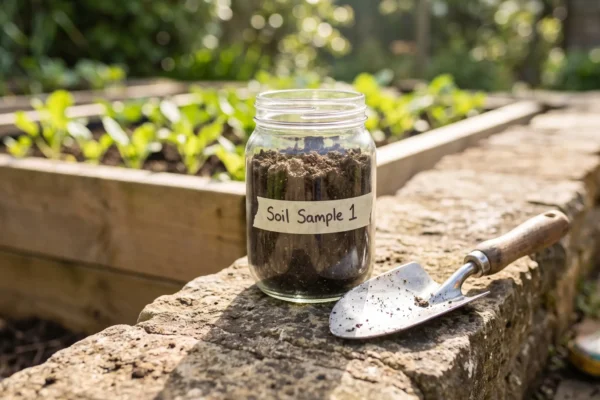
Free and low-cost options exist in Los Angeles County. USC Dornsife’s Public Exchange runs a program that accepts soil samples from residents at no cost, with results in roughly one to two weeks, and posts anonymized results to a public map. The program is explicitly a first screening step rather than a regulatory assessment, so a high reading usually leads to a professional evaluation afterward.
Sample in more than one place. Take separate samples from the vegetable bed, the play area, the drip line below the roof, and near where outdoor grills or heaters stood, since higher readings often clustered around those spots. Surface soil in the top few inches is what matters most for exposure.
Keep in mind what federal cleanup did and did not cover. USC pointed out that federal agencies chose not to test soil after removing debris and the top layer of soil from burned properties, which left homeowners to arrange their own testing.
Should a Child Get a Blood Lead Test?
The researchers who studied the Eaton Fire soil recommended blood testing for vulnerable people, including children, as an added precaution alongside soil testing. Families living in or downwind of a burn area are reasonable candidates for that conversation with a pediatrician.
What the Test Involves
Cost is often less of a barrier than people assume. Many private insurance policies cover blood lead testing, and for children enrolled in Medicaid the cost is covered, with testing required at ages 12 and 24 months.
What the Numbers Mean
No safe level of lead in children has been identified, so even low readings are treated as worth acting on. Follow-up usually means finding and removing the source, a diet higher in iron and calcium, repeat testing, and sometimes a referral to early educational services.
What About Arsenic and the Other Metals in Fire Debris?
EPA lists metals including lead, arsenic, cadmium, chromium, copper, nickel and zinc among the substances that can be present after a structure fire, alongside polycyclic aromatic hydrocarbons, dioxins and furans. The Eaton Fire measurements showed cadmium, arsenic and chromium following the same geographic pattern as lead, but in much smaller quantities.
Arsenic in soil follows the same exposure route as lead. The Agency for Toxic Substances and Disease Registry (2025) notes that elevated arsenic in soil may pose an ingestion risk for children with mouthing behaviors during play, and that children take in more air, water and food per pound of body weight than adults.
One finding offered some reassurance. No asbestos was detected in any of the ash samples the Caltech-affiliated team collected, although that does not rule out asbestos in dust, debris or airborne particles.
A cough or irritation that lingers after a fire is a separate issue from metals in soil, and a cough that started after the fire and never left is worth its own appointment.
How Do You Lower the Risk at Home?
Ash and Dust
Never dry sweep, dust or use a leaf blower. Mist hard surfaces lightly with water before sweeping, then wet mop, using as little water as possible. A HEPA vacuum is better than a household one. Anyone cleaning should wear a NIOSH Approved N95 or P100 respirator, gloves, goggles and long sleeves, and people with heart or lung disease, older adults and pregnant women should not take part in ash cleanup at all.
Wash hands and change clothes and shoes before getting into the car, and bag contaminated clothing before putting it in the trunk. Inside the house, removing shoes at the door and wet-mopping regularly does more than almost anything else, since the Eaton Fire indoor data showed that wiping surfaces with a wet cloth brought about 90% of them below the EPA limit.
Soil Remediation
Covering bare soil also helps. Grass, mulch or ground cover keeps dust from being kicked up and tracked indoors, which is where most children’s exposure actually happens.
Where Can You Find Data for Your Street?
The USC project publishes an interactive map showing sample locations and lead concentrations across the affected areas, and participants receive an identification number to look up their own result. Because readings vary from property to property, a neighborhood map is best read as a reason to test your own yard rather than as a verdict on it.
County public health departments also post wildfire soil and blood-testing information, and some have offered free blood lead testing after the fires. A pediatrician’s office is usually the fastest route to a test, and what a walk-in clinic in Pasadena can and cannot handle is worth knowing before choosing where to go. UCLA Health’s Pasadena clinics see both adults and children.
For a family that cannot easily get out, a clinician who comes to the home can draw blood on site and order the same laboratory work.
Frequently Asked Questions
Does lead in soil break down over time?
It does not. Lead is an element, so it stays in soil indefinitely unless the soil is removed or the lead is bound up by amendments that limit how much the body can absorb.
Can I test my own soil with a home kit?
Home kits are designed mainly for paint and give a rough yes-or-no answer. For a number you can act on, a laboratory analysis of properly collected samples is the usual route.
Do chickens or backyard eggs pick up lead from contaminated soil?
Birds that forage in soil can take in lead, and it can end up in eggs. Anyone keeping backyard hens in or near a burn area generally tests the soil in the run first.
What about the soil under new sod or landscaping installed after the fire?
Covering contaminated soil reduces contact but does not remove the lead underneath. Keep a record of what was covered rather than replaced, because future digging reopens it.
Should adults in the household get tested too?
Adults are usually tested when there is an occupational exposure or a specific reason, rather than routinely. Pregnancy is one situation where a provider may suggest it, since lead crosses to the fetus.
Is it worth testing indoor dust as well as soil?
In many homes it is more informative. Indoor dust is where small children spend their time, and the post-fire measurements showed window areas carried the highest readings.
Sources Used
Free lead soil testing by USC Dornsife researchers helps L.A. residents after wildfires – USC Dornsife (2025)
Protect Yourself from Ash – U.S. Environmental Protection Agency (2026)
Residential Soil Lead Directive for CERCLA Sites and RCRA Hazardous Waste Cleanup Facilities – U.S. Environmental Protection Agency (2025)
Studying Lead in the Environment After the Fires – Caltech Science Exchange (2025)
Testing for Lead Poisoning in Children – Centers for Disease Control and Prevention (2026)