Disclaimer: This article is for general educational purposes only and is not a substitute for professional medical advice, diagnosis, or treatment. Always talk with your doctor or a qualified health provider about your own health.
For decades, the story of knee osteoarthritis has been a one-way street. Cartilage wears down, joints get stiff and painful, and the main goal of care has been to slow the damage or replace the joint. That story is starting to change. A growing field of research now points to an enzyme called 15-PGDH as a possible switch for turning cartilage repair back on, and early studies suggest that blocking it may help the body rebuild worn joint surfaces. In Pasadena and across California, where active adults and aging residents both deal with knee pain every day, this shift in thinking about 15-PGDH and osteoarthritis is worth understanding. This article looks at what the science actually shows, where it stands today, and how it fits alongside the treatments people rely on right now.
What Osteoarthritis Does to Knee Cartilage
The condition is far from rare. According to the Centers for Disease Control and Prevention, roughly 33 million U.S. adults have osteoarthritis, based on national survey data collected from 2017 through March 2020. It becomes more common with age and shows up more often in adults past their mid-forties, though experts stress that it is not simply an unavoidable part of getting older. Extra body weight, past joint injuries, repetitive stress from work or sport, joint misalignment, and family history all raise the odds.
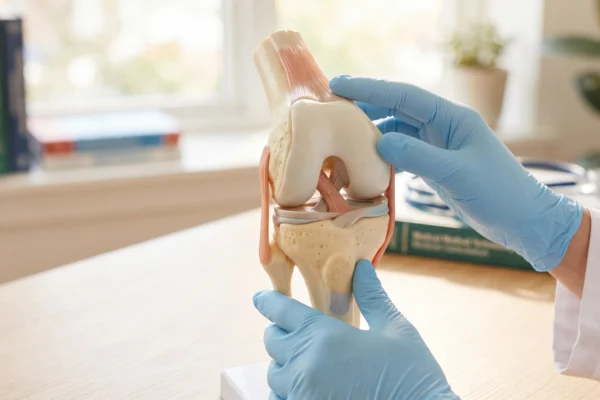
Doctors often describe knee osteoarthritis in stages, from minor wear with no symptoms, to mild and moderate stages with steadily less cartilage, to a severe stage in which cartilage is nearly gone and bones grind directly against one another. Understanding these stages matters because the earlier changes are where regeneration research could one day make the biggest difference. A related and often earlier problem is chondromalacia patella, the softening and breakdown of the articular cartilage on the underside of the kneecap. It shows how cartilage trouble can begin well before a joint reaches the bone-on-bone stage.
Why Knee Cartilage Struggles to Heal on Its Own
This is also why cartilage has no nerves of its own, so the tissue damage itself is not what you feel. Instead, the pain of joint problems tends to come from the inflammation and bone changes that follow once the protective surface wears thin. That distinction matters for treatment, because easing symptoms and actually rebuilding the joint surface are two very different goals.
For most of modern medicine, the assumption has been that lost joint cartilage is gone for good. Care has focused on managing symptoms, protecting the joint, and eventually replacing it with hardware when the damage becomes severe. The promise of cartilage regeneration research is that this assumption may not be the final word, and that the body might still hold the tools to repair itself if the right signal is switched back on.
What Is 15-PGDH, and Why Researchers Call It a Gerozyme
Researchers at Stanford Medicine have described 15-PGDH as a gerozyme, meaning an enzyme tied to aging. Levels of it tend to rise as the body gets older, and that increase appears to dial down the regenerative signals that younger tissue relies on. In other words, part of why aging joints repair themselves so poorly may come down to too much of this single enzyme quietly clearing away the very molecules that would otherwise support healing.
The logic that follows is straightforward. If high 15-PGDH activity suppresses repair, then blocking that activity, using what scientists call a 15-PGDH inhibitor, could raise prostaglandin E2 levels back toward a more youthful range and give tissue a chance to regenerate. That idea has already been explored in aging muscle, and the newest work extends it into the far tougher challenge of cartilage.
How Blocking 15-PGDH Regrew Cartilage in New Research
The findings in mice were striking. Aged animals treated with a small-molecule 15-PGDH inhibitor showed thickening of knee cartilage across the joint surfaces, a reversal of the thinning seen in osteoarthritis. When researchers created knee injuries similar to a torn ligament, the treatment helped protect against the osteoarthritis that developed in half of the untreated animals. Treated mice also moved more normally and put more weight on the affected leg, which suggests the rebuilt cartilage was doing real work.
One of the most interesting details concerns how the repair happened. Rather than recruiting stem cells, the way many tissues heal, cartilage appeared to regenerate through its existing cells, called chondrocytes, shifting their gene activity back toward a more youthful pattern. In the treated joints, a population of chondrocytes that produced 15-PGDH shrank from about 8 percent to 3 percent, a sign that the tissue’s own cells were changing behavior. The team also tested human cartilage taken during knee replacement surgeries. After one week of exposure to the inhibitor, that tissue showed lower activity in cartilage-degrading genes and began to regenerate articular cartilage, an early hint that the same mechanism could translate to people.
Where 15-PGDH Research Stands Today
There is, however, a real path toward the clinic. An oral form of a 15-PGDH inhibitor has already been studied in an early Phase 1 trial for muscle weakness, and it appeared safe in healthy volunteers at that stage. That existing safety groundwork is one reason researchers are optimistic about moving toward trials aimed specifically at cartilage and joints, which the Stanford team has said are planned. Whether the approach is eventually delivered as an injection into the joint or as a pill remains part of what future studies will work out.
For anyone living with knee osteoarthritis right now, the honest takeaway is that 15-PGDH treatment is not yet available and is not a therapy you can ask for at a clinic today. What it represents is a well-founded reason for optimism and a signal of where joint care may be heading. In the meantime, the decisions people face about managing their knees still rest on the options that are proven and available now.
Today's Options for Managing Knee Osteoarthritis
Hyaluronic Acid Injections
Results, though, vary from person to person. Relief, when it comes, often takes a few weeks to appear and typically lasts around six months, and the injections do not help everyone. The most common side effect is mild pain and swelling at the injection site, while roughly 1 percent of people experience a more pronounced flare of joint swelling that a provider can drain. One advantage over steroid shots is that hyaluronic acid injections can be repeated over time without losing effectiveness, which makes them a consideration for people who want to postpone or avoid surgery.
Knee Replacement Surgery
A knee replacement can be total, addressing all three compartments of the joint, or partial, replacing only the damaged section, an approach more often used in younger adults with localized damage. The operation generally takes one to two hours. Recovery is gradual: most people can return to their usual activities within about six weeks, while a full recovery tends to take around a year. Modern implants hold up well, and almost everyone who has a knee replacement enjoys improved knee function for at least 10 to 15 years. This kind of osteoarthritis knee surgery remains one of the most reliable ways to restore mobility once the joint is badly worn.
Robotic Knee Replacement
The approach is growing quickly. About 13 percent of knee replacements currently use robotic assistance, a figure some experts expect to reach 50 percent by 2030. Studies have linked robotic procedures to fewer alignment outliers, fewer complications such as infection and fracture, and shorter hospital stays. The trade-offs include a higher cost per procedure, somewhat longer operating times, and a learning curve for surgeons of roughly 30 to 40 cases. For many patients, the appeal is a more personalized fit tailored to their own anatomy.
How Cartilage Regeneration Fits Into the Bigger Picture of Joint Regeneration
If approaches like this eventually prove safe and effective in people, they could reshape the timeline of osteoarthritis care. Rather than waiting until a joint is severe enough to replace, treatment might one day intervene earlier, when cartilage is only beginning to thin, and help preserve the natural joint for longer. That would be a meaningful change for the millions of people who currently move through a progression that ends, for many, in surgery.
It is worth repeating that this future is not here yet, and current decisions should be based on treatments that exist today. Still, the direction of travel is encouraging. Knowing that serious science is aimed squarely at repair, not just management, can help people feel more hopeful as they work with their care team on the choices in front of them. For those whose knee pain makes getting to appointments difficult, it is also possible to choose a doctor who can come to the home, which can make ongoing care easier to keep up with. Anyone weighing their options can also explore local guidance on orthopedic care in Pasadena, learn more about pain management approaches in the area, and read about care tailored to older adults through resources on senior pain management.
Frequently Asked Questions
What is the function of 15-PGDH?
15-PGDH, short for 15-hydroxy prostaglandin dehydrogenase, is an enzyme whose main job is to break down prostaglandin E2, a signaling molecule that supports tissue repair. Because it clears away a molecule tied to regeneration, it acts like a brake on healing. Researchers have noted that its levels tend to rise with age.
What are 15-PGDH inhibitors?
15-PGDH inhibitors are small molecules designed to block the activity of the 15-PGDH enzyme. By blocking it, they allow prostaglandin E2 levels to rise, which appears to support tissue regeneration in research settings. Scientists have studied both oral and injectable forms in early experiments.
Does 15-PGDH regrow cartilage?
In a 2025 Stanford study published in Science, blocking 15-PGDH promoted cartilage regeneration in aged mice and showed early signs of repair in human cartilage tissue tested in the lab. The regrowth appeared to come from the cartilage’s own cells shifting their gene activity. These are early-stage findings, not an approved treatment.
What is the highest grade of osteoarthritis?
The most advanced stage of osteoarthritis is the severe stage, sometimes described as end-stage or bone-on-bone. At this point the cartilage is nearly gone, so the bones grind directly against each other, which can lead to significant pain and reduced movement. This is often when joint replacement surgery enters the conversation.
Do hyaluronic acid injections work for knee osteoarthritis?
Hyaluronic acid injections are FDA-approved for knee arthritis and aim to lubricate and cushion the joint. Results vary from person to person, and the injections do not help everyone. When they do help, relief often takes a few weeks to appear.
How long does a hyaluronic acid shot in the knee last?
Hyaluronic acid injections are usually given weekly over a course of three to five weeks. When they provide relief, it typically lasts about six months. Unlike steroid shots, they can be repeated over time without losing effectiveness.