This is for informational purposes only. For medical advice or diagnosis, consult a professional.
A blood lead test is the only way to know whether your child took in lead after the Eaton fire. Symptoms will not tell you.
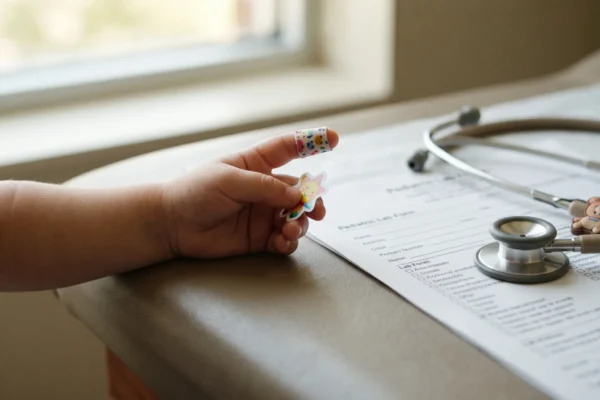
Children under six who live, play or go to daycare downwind of the burn area are the ones worth testing first, along with any child who spends time on bare dirt. The test is a finger prick, sometimes followed by a draw from a vein. The number it produces gets compared with a reference value of 3.5 micrograms per deciliter.
Why Would the Fire Have Put Lead in the Soil?
The Los Angeles County Department of Public Health (2025) published final soil findings for the fire areas. Of the 23 sampling grids covering parcels with intact homes in the Eaton Fire Region, 10 had average lead concentrations above California’s residential soil screening level of 80 milligrams per kilogram, ranging from 80.2 to 167 mg/kg.
The County noted this matched reports of elevated lead in air samples taken in the days right after the fire, and cited a USC Lusk Center finding that more than 70 percent of houses in the region were built before 1979.
Soil matters because of how children meet it. The CDC (2026) explains that children take in lead from soil by swallowing or breathing it while they play, that soil particles travel indoors as dust or on shoes, clothing and pets, that some young children eat soil outright, and that fruit and vegetables grown in or near contaminated soil are another route.
What This Does and Does Not Mean
What Do the 80 and 200 Numbers Actually Mean?
The EPA’s residential soil lead directive (2025) sets a regional screening level of 200 parts per million for lead in residential soil, a removal management level of 600 parts per million, and a target children’s blood lead level of 5 micrograms per deciliter for setting cleanup goals.
California is stricter. The state Department of Toxic Substances Control uses 80 mg/kg as its residential screening level, which is the figure the County measured against. Milligrams per kilogram and parts per million are the same unit, so a yard at 150 sits above California’s line and below the federal one. That is a difference in policy, not in chemistry.
What Crossing the Line Changes
Who Should Get a Blood Lead Test After the Fire?
The CDC (2026) states plainly that a blood lead test is the best way to find out whether a child has lead poisoning, that a child with lead poisoning may have no visible signs at all, and that every child at risk of exposure should be tested. Its risk list includes children who live or spend time in a building put up before 1978.
Locally that covers a lot of families. Much of Altadena and older Pasadena was built well before 1978, the downwind parcels are where the County found its exceedances, and plenty of yards have patches of bare dirt near fences, play equipment and driveways. A dog that comes in dusty counts as a route too.
Infants and Toddlers
If the answer is no and the family has been living, playing or walking a dog in the affected area, that is worth raising at the next appointment rather than at the one after it.
How Is the Test Done, and Does a Lead Blood Test at Home Work?
The CDC’s guidance for providers (2025) describes the two collection methods: a capillary sample taken by finger prick or heel prick, and a venous sample drawn with a needle from a vein. Either can be used for the first screening test, and if a capillary result comes back at or above the reference value, the provider should collect a venous sample to confirm it.
That confirmation step is why a mail-in finger-prick kit is not the end of the process. Even a careful home collection produces a capillary result, and a capillary result at or above the reference value still has to be confirmed by a venous draw and reported to the health department. A home kit can start the conversation. It cannot finish it.
Where to Get the Test Done
How Do You Read an Elevated Blood Lead Level?
It is worth being clear about what that number is not. It is not a line between safe and unsafe, because no safe blood lead level in children has been identified, and it is not a treatment threshold. It is a statistical marker that tells a provider this child’s exposure deserves attention.
How urgently the result gets confirmed depends on how high it is. The CDC publishes this schedule for obtaining a confirmatory venous sample:
| Screening Blood Lead Level (μg/dL) | Time to Confirmation Testing |
|---|---|
| 3.5 to 9 | Within 3 months |
| 10 to 19 | Within 1 month |
| 20 to 44 | Within 2 weeks |
| 45 or higher | Within 48 hours |
Read the top row carefully, because it is the one most families land on. A first result of 4 or 5 is not an emergency, and it is also not something to leave for a year.
What Follows a Result of 3.5 or Above
What Can Lead Do to a Child?
The CDC (2026) lists the documented harms: damage to the brain and nervous system, slowed growth and development, learning and behaviour problems, and hearing and speech problems. It describes these as showing up in lower IQ, reduced ability to pay attention and underperformance at school, and notes evidence that childhood lead exposure can cause long-term harm.
The same page makes the point that drives this whole article. Lead exposure in children is often difficult to see, and most children have no obvious immediate symptoms. Waiting for a symptom is waiting for something that may never arrive on its own.
What Actually Helps at Home
Where Can You See the Data for Your Own Street?
The post-fire surface monitoring results from the County’s assessment task force show where soil, sand and ash were sampled and how the results compared with the screening benchmarks. It is the closest thing to neighbourhood-level data that exists publicly.
Read it with the County’s caveat attached. The sampling was designed to be representative of areas and property conditions, not to describe individual addresses, and the County said individual parcels may differ from the representative samples. Anyone worried about a specific property was advised to test their own soil or consult an environmental professional.
The Gap That Remains
Getting the Test Ordered in Pasadena
If your child does not have a regular provider yet, that is the first thing to fix, and there are practical ways to find a doctor taking new patients in Pasadena without spending three weeks on the phone. Family medicine practices see children as well as adults, which keeps the whole household in one chart.
Cleo T. Williams, MD is one of the family medicine physicians working in Pasadena and the surrounding San Gabriel Valley, covering preventive care and routine testing for both children and adults.
When Getting to an Office Is the Problem
Frequently Asked Questions
Does a normal result mean my child was never exposed?
It means the level in their blood right now is below the reference value. A blood lead test reflects recent exposure more than exposure from years ago, so if a child is still in daily contact with bare soil, ask the provider whether a repeat test makes sense later.
Do pediatricians check for lead at every visit?
No. Blood lead testing happens at set ages or when a child is known to be at risk, not routinely at every appointment. If your child has not had one and you live near the burn area, you usually have to raise it yourself.
Should the adults in the household be tested too?
Adults are not screened the same way, and the rules are different for anyone pregnant or trying to become pregnant, because lead crosses to the baby. If that applies to someone in the house, bring it up at their own appointment.
Does a soil test tell you anything about your child’s blood?
No. A soil test describes the yard and a blood test describes the child. A yard over the screening level does not mean a child has absorbed lead, and a clean yard does not rule out exposure from somewhere else.
Can you reduce exposure without replacing the soil?
In most cases yes, and it is where families usually start. Covering bare dirt with grass, mulch, gravel or raised beds, keeping shoes at the door and damp-dusting indoors all reduce how much soil reaches a child’s hands.
Is a watered lawn enough to keep the dust down?
It helps, because the problem is dry bare soil becoming dust. A lawn is not a barrier on its own, though, and patchy areas under play equipment, along fences and beside driveways are usually the ones a child actually digs in.
Sources Used
Lead Exposure Symptoms and Complications – Centers for Disease Control and Prevention (2026)
LA County final report confirms elevated lead in soil downwind from Eaton fire – Pasadena Star News (2025)
Recommended Actions Based on Blood Lead Level – Centers for Disease Control and Prevention (2025)
Residential Soil Lead Directive for CERCLA Sites and RCRA Hazardous Waste Cleanup Facilities – U.S. Environmental Protection Agency (2025)
Surface Monitoring – Los Angeles County Post-Fire Assessment Task Force
Testing for Lead Poisoning in Children – Centers for Disease Control and Prevention (2026)