This is for informational purposes only. For medical advice or diagnosis, consult a professional.
Medicare hospice in Pasadena covers four levels of care – routine home care, continuous home care, general inpatient care, and respite care – for patients whose physician has certified a life expectancy of six months or less if the illness runs its normal course (Medicare.gov). Beneficiaries pay nothing for hospice services, up to a $5 copay per outpatient prescription for pain or symptom management, and 5% coinsurance for inpatient respite care. Coverage includes nursing, social work, chaplaincy, durable medical equipment, medications related to the terminal illness, and bereavement support for at least 13 months after the patient’s death (CMS Medicare Hospice Benefits). The hospice team works with the patient’s attending physician, if the patient has one, to develop and update the plan of care.
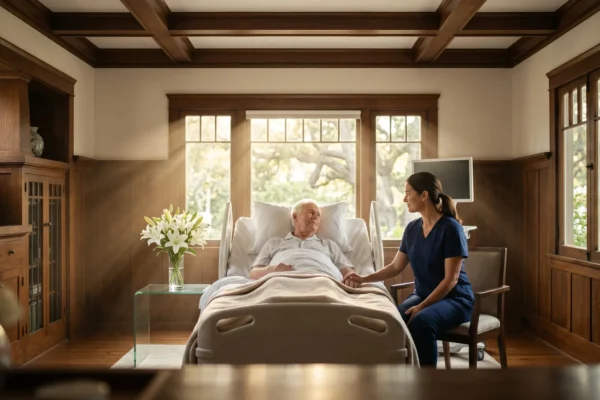
What does the Medicare hospice benefit cover in Pasadena?
Patients keep their right to standard Medicare coverage for any condition unrelated to the terminal diagnosis. Original Medicare also continues to pay an attending physician of the patient’s choice for services related to the terminal illness, in parallel with the hospice agency.
The four levels of hospice care under Medicare
| Level of care | When it applies | Where it is provided |
| Routine home care | Day-to-day care when the patient is not in crisis | Home, assisted living, or skilled nursing facility |
| Continuous home care | Short periods of crisis requiring mainly nursing care | Patient’s home setting |
| General inpatient care | Pain or symptom management that cannot be handled at home | Medicare-approved inpatient facility |
| Respite care | Short stay to give the family caregiver a break | Medicare-approved facility, up to 5 consecutive days at a time |
Source: Medicare.gov and CMS Hospice payment fact sheet.
Who qualifies for hospice under Medicare?
The benefit is divided into periods: two 90-day periods followed by an unlimited number of 60-day periods. Before each period after the first 90 days, a hospice physician or nurse practitioner must recertify the prognosis, including a face-to-face encounter starting with the third period. Patients can leave hospice and return to standard Medicare at any time, and can change hospice providers once during each benefit period.
What services does the in-home hospice team provide?
The composition of the team is set by Medicare regulation. Each role plays a specific part in keeping the patient comfortable at home.
- Medical director or hospice physician – oversees the medical plan of care
- Registered nurses – provide skilled visits and manage symptoms
- Hospice aides – help with bathing, dressing, and personal care
- Social workers – help with planning, paperwork, and community resources
- Chaplains or spiritual counselors – provide non-denominational spiritual support
- Bereavement counselors – support the family before and after the patient’s death
- Trained volunteers – companionship and practical help
- Therapists – physical, occupational, and speech therapy when included in the plan of care
A foundational review of hospice in the US can be found in the StatPearls chapter on hospice care (Bhatnagar et al., updated 2023).
What medical equipment does a Pasadena hospice agency supply?
| Equipment | Purpose at home |
| Hospital bed | Safe positioning and skin care |
| Pressure-relief mattress | Reduces risk of pressure injuries |
| Oxygen concentrator | Supports breathing and comfort |
| Wheelchair or walker | Safe transfers and mobility |
| Bedside commode | Toileting when bathroom access is limited |
| Personal care supplies | Hygiene and continence care |
Source: Medicare Hospice Benefits booklet (CMS, 2026).
How do you prepare a Pasadena home for hospice care?
A practical preparation checklist:
- Room choice – pick a quiet room that is still close to family life, not isolated at the back of the house
- Pathways – clear a path wide enough for a hospital bed and wheelchair, typically at least 32 to 36 inches
- Lighting – add motion-sensor nightlights in hallways and the bathroom
- Trip hazards – remove loose rugs, cords, and small furniture from walking paths
- Communication – place a call bell or baby monitor within the patient’s reach
- Bathroom – install grab bars near the toilet and shower
- Sanitation – set up a station for gloves, hand sanitizer, and wipes
Comfort – check that the room has good temperature control and soft lighting at night
Which Medicare-certified hospice providers serve Pasadena?
- Liem Hospice – serves Pasadena, Burbank, Glendale, North Hollywood, Studio City, Sherman Oaks, and surrounding communities in the Greater Los Angeles area.
- Westlake Village Hospice, Inc. – serves Pasadena and Monrovia alongside Westlake Village, Thousand Oaks, Simi Valley, and other communities in Los Angeles and Ventura counties.
When comparing agencies, the criteria that matter most for an in-home program:
| Criterion | What to look for |
| Medicare certification | Required to bill the hospice benefit |
| On-call availability | A registered nurse reachable 24/7 |
| Response time | How quickly a nurse can be at the home in a crisis |
| Staff stability | Lower turnover means the family sees familiar faces |
| Bereavement support | At least 13 months after the patient’s death, per CMS requirements |
| Languages spoken | Important for non-English-speaking households |
How can families handle non-terminal health issues without a clinic trip?
An in-home physician visit is one practical alternative. Services such as Doctor2me can bring a clinician to the patient’s residence for non-terminal complaints, which keeps the home environment stable and reduces transport burden on the family.
Practical advantages of an in-home visit for a hospice patient:
- No vehicle transfers or wheelchair logistics for the family
- Lower infection exposure than a clinic waiting room
- Assessment in the environment where the patient lives
- One-on-one time with the clinician
- Reduced disruption to the hospice schedule
How does technology support comfort at home?
Non-drug approaches to anxiety and pain are also part of modern hospice practice. A 2025 review of virtual reality for pain and anxiety reported measurable reductions in patient-rated pain and anxiety across a range of clinical settings, including oncology and chronic pain.
| Tool | Benefit for the patient | Benefit for the family |
| Wearable sensors | Non-invasive vital sign tracking | Reassurance overnight |
| Digital health portal | Visible care plan and notes | Clear communication with the team |
| Video consultations | Faster clinical advice | Fewer emergency calls |
| Smart lighting | Better sleep-wake cycles | Safer nighttime movement |
What bereavement support do families receive?
Components of a typical bereavement program:
- Initial assessment – identifying the emotional needs of each family member
- Follow-up contacts – scheduled check-ins throughout the 13-month period
- Support groups – local groups where families can meet others with similar experiences
- Individual counseling – referrals when grief is acute or complicated
- Memorial services – community remembrance events organized by the hospice
- Educational materials – age-appropriate resources for children and adults
How do advance directives fit into hospice care?
Documenting wishes in an advance directive – a living will, a durable power of attorney for health care, or a POLST form – gives the hospice team a clear framework for decisions. The Mayo Clinic guide to living wills and advance directives explains the documents in plain language and covers what to include for cardiopulmonary resuscitation, ventilation, tube feeding, and organ donation.
Frequently Asked Questions
Who qualifies for the Medicare hospice benefit?
A patient with Medicare Part A whose hospice physician and attending physician (if the patient has one) certify a life expectancy of six months or less if the illness runs its normal course. The patient signs an election statement to begin hospice and can return to standard Medicare at any time (Medicare.gov).
What does Medicare actually pay for under hospice?
Nursing visits, home health aide visits, social work, chaplaincy, bereavement counseling, durable medical equipment, and medications related to the terminal illness. Patients pay $0 for hospice services, up to $5 per outpatient prescription for pain or symptom management, and 5% coinsurance for inpatient respite care.
Can a hospice patient still see their regular doctor?
Yes. The patient can name an attending physician of their choice, and Medicare continues to pay that physician for services related to the terminal illness in parallel with the hospice benefit. The hospice team develops the plan of care together with the attending physician.
Does the hospice provide medical equipment for the home?
Yes. The hospice agency delivers and maintains the durable medical equipment in the plan of care – including hospital beds, oxygen concentrators, and mobility aids – at no additional cost to the family.
How long does bereavement support last?
At least 13 months after the patient’s death, per CMS Hospice Conditions of Participation. Support typically includes follow-up contacts, group meetings, and referrals for individual counseling if grief is complicated.
How can families handle non-terminal issues like a cold or minor rash?
An in-home physician visit can substitute for a clinic trip, which keeps the patient’s environment stable and reduces exposure to infections in public waiting rooms.