This is for informational purposes only. For medical advice or diagnosis, consult a professional.
If your doctor ordered an MRI, a CT scan, or a plain X-ray and you are not sure what the difference is, here is the short version. An X-ray is fast and best for bones, a CT scan gives a detailed 3D view for trauma and organs, and an MRI shows soft tissue in fine detail without radiation. Which one you get depends on what your doctor needs to see.
Getting an imaging order can feel confusing, and a little worrying. You may wonder if it is really needed, whether it is safe, and what it will cost.
This guide walks through each scan in plain language, so you can read your order with less stress and ask better questions.
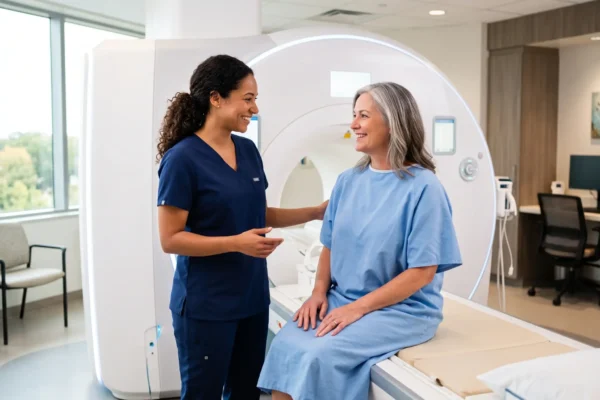
What Is the Difference Between an X-Ray, CT Scan, and MRI?
Think of it as a range from quick and simple to slow and detailed. An X-ray is the fast first look, a CT scan adds depth and speed for emergencies, and an MRI gives the richest view of soft tissue.
Here is a simple side-by-side:
How a Flu Vaccine Works
The seasonal flu vaccine for 2026-2027 protects against three influenza viruses. You need a fresh one each year for two reasons: protection fades over months, and the viruses themselves keep changing.
| Test | What It Shows Best | Radiation? | Typical Time |
|---|---|---|---|
| X-ray | Bones, fractures, dislocations | Yes, very low | A few minutes |
| CT scan | Detailed 3D views for trauma, bleeding, and organs | Yes, more than an X-ray | Under a minute of scanning |
| MRI | Soft tissue: ligaments, nerves, brain, spine, tumors | No ionizing radiation | About 20 to 60 minutes |
One more test is worth knowing about. An ultrasound uses sound waves, not radiation, and is often the first choice for looking at the abdomen, blood vessels, or a pregnancy. Your order will name whichever test fits the question best.
None of these tests is “better” in general. Each one is a different tool, and the right choice depends entirely on what part of the body is involved and what your doctor needs to rule in or out.
Why Did My Doctor Order This Specific Scan?
Often your doctor has already talked it through with a radiologist. Johns Hopkins describes radiologists as “the doctor’s doctor,” and notes you are welcome to ask why a particular test was chosen.
Common reasons a specific scan gets ordered include:
- An X-ray to check a bone after a fall or to rule out a fracture
- A CT scan to look quickly at the head, chest, or belly after an injury
- An MRI to study a joint, the spine, nerves, or a soft-tissue problem
- Contrast added when your doctor needs to see blood flow or inflammation more clearly
Sometimes imaging is part of a larger plan, like a referral to a specialist. Knowing what to expect from that process can make the whole thing feel less mysterious. It is always fair to ask what the scan is looking for and how the result will change your care.
Do X-Rays and CT Scans Expose Me to Dangerous Radiation?
A CT scan uses more than a plain X-ray because it takes many images, but it is still considered a low-risk test for most people. Imaging centers follow a principle called ALARA, which means keeping radiation as low as reasonably achievable while still getting a useful picture.
An MRI uses no ionizing radiation at all, since it works with a magnet and radio waves. If radiation worries you, the Cleveland Clinic notes that MRI is often chosen exactly because it avoids it. You can always ask your doctor whether a radiation-free option would answer the same question.
The real risk to avoid is not getting an answer at all. A missed fracture or an undiagnosed problem usually carries more risk than a low-dose scan.
What Does MRI With Contrast or Without Contrast Mean?
The dye used in MRI is different from the dye used in CT. RadiologyInfo.org notes that reactions to contrast are uncommon and usually mild, and staff screen you first to keep it safe.
Your doctor decides whether contrast is needed based on what they are looking for. If your order says with and without contrast, it simply means the team wants both views for a fuller picture. If you have kidney problems or past reactions, tell the staff before your scan.
How Much Does an MRI or CT Scan Cost, and How Do I Avoid Overpaying?
A few simple steps can protect your wallet:
- Ask for the exact name of the scan, including whether contrast is included
- Call a few imaging centers and ask for the cash or self-pay price
- If you have insurance, check whether the center is in network and if you need prior approval
- Ask whether a freestanding imaging center is an option, since it is often less costly than a hospital
- Keep the order and any prior images, so you do not pay to repeat a scan
It also helps to know your local options. Our guide to where to get an MRI in Pasadena walks through nearby imaging centers so you can compare. For emergencies, a Pasadena emergency room can do a CT scan on the spot, though it is the most expensive setting.
Can Imaging Come to Me at Home?
Mobile services handle the more portable studies, like X-rays and ultrasounds. Gentry Imaging, which offers mobile X-ray and EKG with same-day orders, can come to a home or care facility in the Pasadena area.
For ultrasound and portable X-ray together, Professional Imaging Network provides mobile diagnostic imaging read by board-certified radiologists. MRI and CT still need a center because of the size of the machines, but a lot can be handled at home.
If you also need a checkup or an order written, a clinician who visits patients at home can arrange routine imaging without a trip out. Screening tests like a mammogram still happen at a center, but your regular care can start at home.
What If I Am Anxious About the Results?
A few things can ease the wait. Ask your doctor when and how you will get the results, and whether a normal result will simply be posted to your portal.
It can also help to keep the day of the scan low-key. Bring a friend if you are nervous, wear comfortable clothing without metal, and give yourself time so you are not rushing. Small comforts make the appointment easier.
If a scan does find something, remember that a clear picture is what makes good treatment possible. Finding a problem early usually means more options, not fewer. Bring your questions to the follow-up visit, and let your doctor walk you through what the images mean for you.
Frequently Asked Questions
Can I eat before an MRI or CT scan?
It depends on the scan. Many MRIs and X-rays let you eat normally, but some scans, especially those using contrast, ask you to skip food for a few hours. Your imaging center will give you specific instructions when you book.
Why can’t I have an MRI if I have metal implants?
An MRI uses a very strong magnet, so certain metal implants, pacemakers, or devices can be unsafe or blur the images. Always tell the staff about any implants, and they may suggest a CT scan instead.
Is contrast dye hard on my kidneys?
For most people it is not a problem. If you have kidney disease, the team may check your kidney function first or choose a scan without contrast. Share your medical history so they can pick the safest option.
Do I need a referral to get an MRI in Pasadena?
Usually yes. Most imaging centers and insurance plans want an order from a doctor, and some scans need prior approval. Your provider’s office can send the order and help with any approval.
How soon will I get my results?
Simple X-rays are often read quickly, while an MRI or CT may take a day or two for the radiologist to review and report. Ask your doctor when to expect results and how you will receive them.
Can I ask for a scan without radiation?
You can always ask. In some cases an MRI or ultrasound can answer the same question without ionizing radiation, but not always. Your doctor can explain whether a radiation-free option fits your situation.